


Basic facts about the religion, caste, and ethnicity of Nepalese people
With distinct climatic conditions and geographic differences, Nepalese people have unique features in terms of human social diversity and their customs. Above them, eighty percent of Nepalese follow Hinduism, while rest of the population worships Buddhism and other local religions. The population constitutes various groups of different races that are further divided into different caste systems. The distinction in caste and ethnicity is understood more easily with a view of traditional hierarchy and stratification of the population. Looking at the existing myriad layers which are prevalent in caste system, Nepal sustains the features of multiethnic society.
Basically, some of the ethnic groups are: Gurungs and Magars who live mainly in the western region of Nepal; Rais, Limbus, and Sunuwars who live in the eastern mid hills; Sherpas, Manangis, and Lopas who live near the mountains of Everest, Annapurna, and Mustang respectively; Newari community have strongholds in Kathmandu, the capital city of Nepal; Tharus, Yadavas, Satar, Rajvanshis, and Dhimals are found in the Terai region; and Brahmins, Chhetris, and Thakuris generally are over all parts of the country. In this respect, ethnic heterogeneity and mutual coexistence are foundational layers of Nepalese people.

Multiple ethnic groups speak more than a hundred languages in different dialects whereas Nepalese language is spoken throughout the country as the official language. English is spoken by many in government and business offices. It is the mode of education in most private schools of Kathmandu and some other cities as well.
In the northern region of the Himalayas are the Tibetan – speaking groups namely Sherpas, Dolpas, Lopas, Baragaonlis, Manangis. The Sherpas are mainly populous in the east in the Solu and Khumbu region; the Baragaonlis and Lopas live in the semi-deserted areas of Upper and Lower Mustang; the Managis live in areas of Manang district; while the Dolpas live in Dolpa district of West Nepal, one of the highest settlements on earth at 4,000 meters.

Several ethnic groups live together in harmony in the middle hills and valleys. Among them are the Magars, Gurungs, Tamangs, Sunuwars, Newars, Thakalis, Chepangs, and the majority of Brahmans and Chhetris. The Brahmans and Chhetris have dominance in all spheres of social, religious and political life. There are also some occupational castes namely: Damai (tailor), Sarki (cobbler), Kami (blacksmith) and Sunar (goldsmiths).
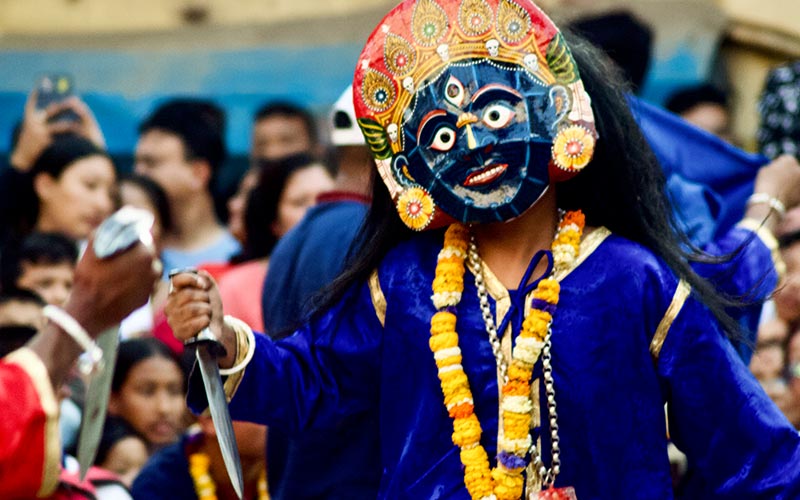
Kathmandu Valley represents the cultural backbone of the country, where people from varied backgrounds have come together to form a vibrant melting pot. The natives of the valley are the Newars, whose rich culture beautifully integrates both Hinduism and Buddhism. To explore the heritage, traditions, and spiritual landmarks of this fascinating region, consider joining our Kathmandu Tour.
The main ethnic groups in Terai are Tharus, Darai, Kumhal, Majhi and other groups that have roots in India. They speak north Indian dialects like Maithili and Bhojpuri. There are, however, some occupational castes like Majhi (fisherman), Kumhal (potter) and Danuwar (cart driver).
Overall, with the presence of hundreds of caste divisions and their mutual interdependence preserves Nepalese’s uniqueness. The different ethnic groups have different living customs within the nation.
Experience Nepal Beyond the Mountains
Understanding Nepal’s diverse cultures and communities adds deeper meaning to your journey. Whether you’re trekking through remote villages or exploring ancient heritage sites, let us help you connect with the heart of Nepal.
👉 Plan your cultural tour with Himalayan Glacier today.

A leading adventure & tour operator in the Himalayas since 1992, Himalayan Glacier Adventure & Travel Company® is the #1 guiding adventure travel company on Mount Everest Base Camp and beyond with 98% success rate. Each of our holidays is truly a tailor-made package which we design for all ages, groups, families & solo travelers.

