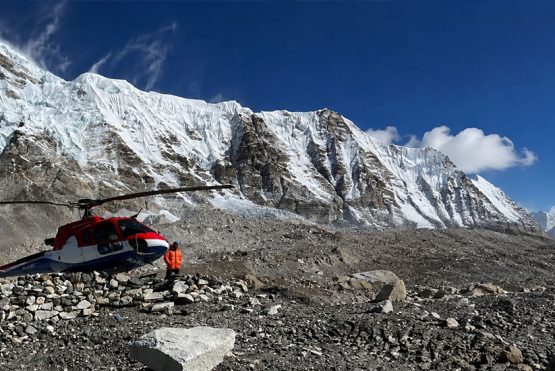
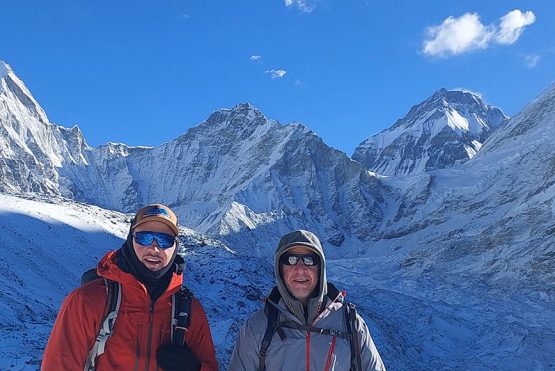
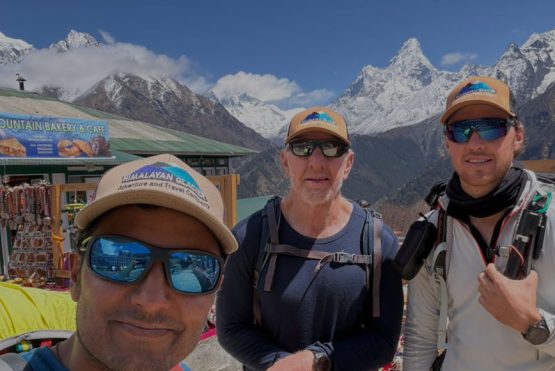
On October 19, 2025, at approximately 12:36 p.m. Nepal time, Dr. David McClung of Olathe, Kansas stood at Everest Base Camp 5,364 meters above sea level, at the foot of the world’s highest mountain completing the iconic Everest Base Camp Trek. He had just walked there on foot across eight days of high-altitude mountain trails, swinging bridges, and Sherpa villages. He was 82 years old. His journey, later detailed in this account of how an 82-years-old reached Everest Base Camp shows what preparation and guidance can achieve.
His family announced the achievement on social media, calling him the oldest person to reach Everest Base Camp. He made the journey with his son, Dennis. His guide was Aasbir Gurung of Himalayan Glacier. And when people asked how it was possible, how an 82-year-old physician from Kansas ends up standing at the base of Everest, the answer wasn’t a mystery: it was preparation, the right guide, and the willingness to respect the mountain’s terms.
Dr. McClung’s story isn’t here to suggest that EBC is easy. It isn’t. But it is here to recalibrate what you think is possible and to explain, honestly, what it actually takes.
Part 1: How Hard Is the Everest Base Camp Trek, Really?
The Numbers First
- Total distance: ~130 km (80 miles) round-trip, Lukla to Base Camp and back
- Maximum elevation: 5,364 m (17,598 ft) at Everest Base Camp
- Highest sleep elevation: ~5,140 m (16,863 ft) at Gorak Shep
- Duration: Typically 12–14 days
- Daily trekking: 4–8 hours of walking per day, depending on the stage
- Total elevation gain (cumulative): Approximately 8,400 m (27,560 ft) of total ascent across the full route, not a continuous climb, but significant daily effort
What the Terrain Is Actually Like
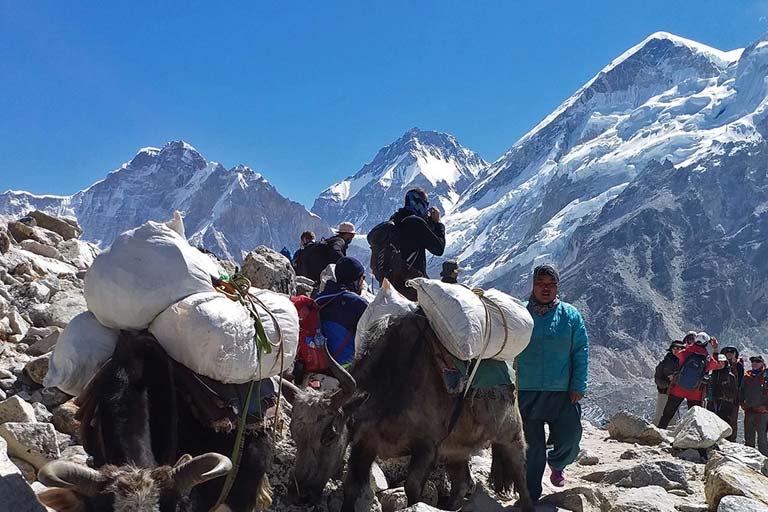
Everest Base Camp trek doesn’t involve technical climbing. You’re walking on established trails the entire way, no ropes, no crampons (except in some early-spring conditions near Khumbu Glacier), no vertical rock faces. But “just walking” understates the reality.
The trail between Lukla and Base Camp is relentlessly up-and-down. You don’t simply gain elevation smoothly, you’ll drop 400 m / 1,312 ft to cross a river valley, then climb 600 m / 1,968 ft to the next ridge. Your legs accumulate far more vertical than the net elevation gain suggests. By Day 8 or 9, even experienced hikers find their legs tired in a way that flat-country hiking never produces.
The trail surface varies: paved stone steps in the lower sections, rocky uneven terrain higher up, loose scree near the glacier approach. The famous Namche Hill; a relentless 600-meter / 1968 feet climb from Monjo to Namche Bazaar greets you on Day 3 and serves notice that this is not a casual walk.
The Honest Difficulty Rating
On a standardized trekking scale, EBC sits at moderate-to-demanding for physically active adults who prepare properly. The key word is prepare. The trek rewards those who arrive ready and punishes those who don’t. For a more detailed breakdown of terrain, altitude impact, and daily challenges, see this guide on Everest Base Camp Trek Difficulty.
It is not appropriate for:
- Complete non-exercisers with no preparation time before the trek
- People with certain cardiac or respiratory conditions without prior medical clearance
- Young children under approximately 10–12 years, depending on maturity and fitness
It is appropriate for:
- Active adults across a remarkably wide age range. Dr. McClung at 82 is proof that the ceiling is higher than most people assume
- People who commit to 8–12 weeks of cardio and leg-strength preparation
- First-time high-altitude trekkers with a good base fitness level and the right guide
The question is never really “Am I too old?” or “Am I fit enough?” The question is: “Am I willing to prepare?”


Part 2: The Real Challenge: Altitude
Of all the factors that determine whether you reach Base Camp, altitude is the most important and the least understood by first-time trekkers. Physical fitness matters. Mental resilience matters. But altitude doesn’t care how fit you are or how old you are.
Why Altitude Affects You
As you gain elevation, the atmospheric pressure drops. The percentage of oxygen in the air stays the same about 21% but each breath delivers fewer oxygen molecules. At 5,364 m / 17,598 ft (Everest Base Camp), the effective oxygen availability is roughly half of what you breathe at sea level.
Your body responds by increasing breathing rate and heart rate, producing more red blood cells over time, and redistributing blood flow. This process acclimatization takes days, not hours. Your body can adapt, but only if you give it time.
When you ascend faster than your body can adapt, the result is Acute Mountain Sickness (AMS) and on the EBC trail, it’s not rare.
Acute Mountain Sickness (AMS): What It Feels Like
AMS typically begins above 2,500 m (8,200 ft), though susceptibility varies enormously between individuals. There is no reliable predictor age, fitness, and prior altitude experience are poor indicators of who will get AMS. A 35-year-old marathon runner can struggle while a 70-year-old who prepared carefully sails through.
Common AMS symptoms:
- Headache (the hallmark symptom persistent, often throbbing)
- Severe exhaustion not matching physical effort
- Dizziness or lightheadedness
- Nausea or vomiting
- Loss of appetite
- Difficulty sleeping
- Shortness of breath at rest
Mild AMS is extremely common on EBC treks and usually resolves with rest, hydration, and no further ascent. The critical discipline is not ascending with AMS symptoms doing so risks progression to the two serious altitude conditions.
HACE and HAPE: When Altitude Becomes Life-Threatening
High Altitude Cerebral Edema (HACE) occurs when fluid accumulates in the brain. Symptoms include severe headache unresponsive to ibuprofen, loss of coordination, confusion, and in extreme cases, loss of consciousness. HACE is a medical emergency requiring immediate descent and supplemental oxygen.
High Altitude Pulmonary Edema (HAPE) occurs when fluid accumulates in the lungs. Symptoms include breathlessness at rest, a persistent worsening cough, extreme fatigue, and cyanosis (blue lips or fingertips). HAPE is the most common cause of altitude-related death and demands immediate descent.
Both conditions are rare when proper acclimatization protocols are followed. Both become dangerous when guides or trekkers ignore early warning signs or push through symptoms in pursuit of the summit view.
This is why the guide’s role isn’t just navigational. It’s clinical.

Part 3: Acclimatization: The System That Keeps You Safe
The Golden Rule: Climb High, Sleep Low
The foundational principle of acclimatization and altitude risk management is deceptively simple: you can walk to higher altitude during the day, but you should sleep at the same or lower elevation to give your body maximum recovery time overnight.
The classic EBC itinerary is designed around this principle. The two built-in acclimatization days typically at Namche Bazaar (3,440 m / 11286 ft) and Dingboche (4,410 m / 14468 ft) are not rest days for your legs. They’re physiological adaptation days. You’ll hike to a higher viewpoint during the day, then descend to sleep at the same altitude as the night before.
Why Rushing Kills Trips
The standard EBC itinerary takes 12–16 days for a reason. “Trek in 10 days” packages occasionally circulate in the budget market. They skip acclimatization days, push elevation gains beyond safe daily limits, and dramatically increase AMS risk. Dr. McClung’s guided eight-day trek from the trailhead (not including Kathmandu preparation days) moved at the pace his guide determined was appropriate for him not the pace that minimized hotel costs.
The safe guideline above 3,000 m / 9,843 ft is to not increase sleeping elevation by more than 300–500 m per day, with a rest day every three days. A quality operator builds itineraries around this principle.
The Acclimatization Schedule on a Well-Run Everest Base Camp Trek
| Day | Stage | Sleep Elevation | Notes |
|---|---|---|---|
| 1 | Arrival in Kathmandu | 1,350m/4,429ft | Preparation |
| 2 | Lukla to Phakding | 2,610m/8,563ft | Gradual start |
| 3 | Phakding to Namche Bazaar | 3,438m/11,280ft | Famous Namche climb |
| 4 | Acclimatization day — Namche | 3,438m/11,280ft | Hike high, sleep low |
| 5 | Namche to Tengboche | 3,870m/12,697ft | Monastery views |
| 6 | Tengboche to Dingboche | 4,360m/14,305ft | Above treeline |
| 7 | Acclimatization day — Dingboche | 4,360m/14,305ft | Ridge hike to 5,100m+ |
| 8 | Dingboche to Lobuche | 4,940m/16,208ft | Cold, exposed |
| 9 | Lobuche to Gorak Shep + Base Camp | 5,364m/17,599ft | Summit day |
| 10 | Gorak Shep – Kala Patthar to Pheriche | 5,545m/18,193ft | Rapid descent |
| 11 | Pheriche to Namche Bazaar | 3,438m/11,280ft | Increasing oxygen, rapid recovery |
| 12 | Namche Bazaar to Lukla | 2,800m/9,187ft | Preparation for Kathmandu Flight |
| 13 | Lukla to Kathmandu | 1,350m/4,429ft | Short Scenic Flight |
| 14 | Final Departure | Heartfelt Goodbye |
Note: Itineraries vary by operator and departure. This represents a standard 14-day structure.
This 14-day Everest Base Camp itinerary is carefully designed to balance steady altitude gain, proper acclimatization, and comfortable trekking days through the heart of the Khumbu region. For a complete day-by-day breakdown with services, inclusions, and booking details, explore the full Everest Base Camp Trek itinerary.
Part 4: Altitude Sickness Prevention: What You Can Actually Do
Before You Leave Home
- Build cardiovascular fitness. Your aerobic engine is your most important piece of gear. Eight to twelve weeks of consistent cardio training hiking, running, cycling, stair climbing with emphasis on sustained effort rather than intensity. Long weekend hikes with a loaded pack are ideal. If you can comfortably hike 6–8 hours with 10–15 kg on your back before you arrive in Nepal, you’re ready.
- Train on elevation if you can. If you live near mountains, get to altitude before EBC. Even a night or two above 3,000 m / 9,843 ft gives your body some prior experience with low-oxygen conditions. Many US trekkers make a pre-EBC trip to Colorado’s high peaks for exactly this reason.
- Consult your physician about Acetazolamide (Diamox). Diamox is a prescription medication that accelerates acclimatization by stimulating increased breathing rate. It’s widely used by EBC trekkers and recommended by many wilderness medicine practitioners. It is not a guarantee against AMS, and has side effects including tingling extremities and increased urination. Talk to your doctor ideally a travel medicine specialist at least six weeks before departure.
- Get a pre-trek medical check. If you have any cardiac, respiratory, or blood pressure concerns, a pre-trek medical clearance is worth the hour. High altitude places real demands on the cardiovascular system. This is true for all trekkers and doubly worth doing for those in their 60s, 70s, or beyond. Dr. McClung, as a physician himself, understood exactly what his body was being asked to do.
On the Trail
- Hydrate aggressively. Dehydration amplifies AMS symptoms significantly. Aim for 3–4 liters of water per day on the trail. Many trekkers mistake dehydration headaches for altitude headaches and reach for ibuprofen when water is the actual answer.
- Ascend slowly. Resist the temptation to race ahead of your group or push for more distance on high-energy days. The trail rewards patience. Many trekkers who feel fantastic through Namche pay for it above 4,000 m / 13,123 ft.
- Eat even when you don’t want to. Altitude suppresses appetite. A trekker who stops eating loses energy reserves rapidly, becomes more susceptible to cold, and recovers from exertion more slowly. Force the meals especially carbohydrate-dense ones like dal bhat, rice, and noodles.
- Avoid alcohol. At altitude, alcohol is a vasodilator that worsens AMS symptoms and impairs sleep quality. Save the celebration for Kathmandu.
- Report symptoms immediately. This is the most important point on this list. Tell your guide at the first sign of a persistent headache, nausea, or unusual fatigue. The hardest thing to do at altitude is admit you feel bad when Base Camp is two days away. The most important thing your guide needs is your honesty.
Part 5: How Guided Treks Manage Altitude Risk
This is where the difference between a guided trek and an independent attempt becomes most consequential and where Dr. McClung’s success illustrates the point most clearly. At 82, he didn’t make it to Base Camp in spite of having a guide. He made it in significant part because of one.
1. Daily Health Assessments
A trained guide conducts daily symptom checks asking the right questions, observing your gait for coordination issues, monitoring your breathing rate, and noting changes in your energy or demeanor. These aren’t bureaucratic check-ins. They’re clinical observations by someone who has watched dozens of trekkers move through altitude and knows exactly what normal looks like versus what concerning looks like.
Guide Aasbir Gurung managed Dr. McClung’s progression across eight days of trekking adjusting pace, monitoring health, and ensuring that an 82-year-old trekker’s safety was the constant priority, not the itinerary schedule.
2. Pulse Oximetry Monitoring
Quality operators equip guides with pulse oximeters small devices that measure blood oxygen saturation (SpO₂). At sea level, healthy adults typically read 95–100% SpO₂. At EBC altitude, 80–85% is common; readings below 70% indicate significant concern.
Daily SpO₂ monitoring gives your guide an objective data point alongside subjective symptom reports. It catches declining oxygen levels before the trekker feels dramatically ill, critical for any trekker, and especially for older trekkers whose symptoms may present differently.
3. Emergency Descent Protocols
If a trekker develops significant AMS or shows early signs of HACE or HAPE, the only treatment is descent. Not rest. Not medication alone. Descent.
A quality operator has emergency descent protocols defined before the trek begins: clear thresholds for mandatory descent decisions, communication systems to contact Kathmandu operations, pre-arranged relationships with helicopter rescue companies, and critically guide authority to override a trekker’s desire to push on. Altitude impairs judgment. The guide’s judgment must stay external to that impairment.
At Himalayan Glacier, our guides have the authority and the obligation to make descent calls. No summit view overrides a trekker’s safety. This policy has no exceptions regardless of age, fitness level, or how close to Base Camp you are when the call needs to be made.
4. Supplemental Oxygen and Gamow Bags
High-altitude guides on quality-operated treks carry portable supplemental oxygen for emergency stabilization while descent logistics are arranged. Gamow bags (portable hyperbaric chambers) are available at key teahouses along the EBC route most notably at Pheriche, where the Himalayan Rescue Association maintains a staffed medical post. A Gamow bag simulates descent by increasing internal air pressure, providing rapid relief from serious altitude illness when immediate physical descent isn’t possible.
Your guide knows where these resources are. Most trekkers don’t.
Part 6: Physical and Mental Preparation: The Full Picture
What “Trek-Ready” Actually Means
“I go to the gym three times a week” is a starting point, not a finish line. EBC-ready fitness means:
- Sustained aerobic capacity: You can hike 6+ hours with a 10–12 kg daypack without significant distress
- Leg strength and endurance: Downhill matters as much as uphill descent days are long and hard on the knees
- Core stability: Carrying a pack over uneven terrain for two weeks stresses the lower back
- Mental stamina: The ability to keep moving when you’re tired, cold, and at altitude-suppressed morale
A 12-week preparation program combining 3–4 cardio sessions per week, 2 leg-focused strength sessions (squats, lunges, step-ups, deadlifts), and progressively longer weekend hikes will prepare most healthy adults adequately. For trekkers in their 60s and beyond, add dedicated balance and stability work uneven trail surfaces at altitude demand proprioceptive awareness that flat-surface gym training doesn’t fully build.
Gear That Matters for Altitude and Cold
Above 4,000 m / 13,123 ft, the EBC trail is cold often below freezing at night and exposed to wind during the day. Cold amplifies fatigue and suppresses the will to eat and drink.
Essential cold-weather gear:
- Down jacket (rated to -10°C or lower): non-negotiable above Namche
- Warm base layers: (moisture-wicking – cotton is genuinely dangerous at altitude)
- Trekking poles: significantly reduce knee stress on descent and improve stability on uneven terrain
- Quality waterproof shell: rain and wind are guaranteed at some point
- Warm gloves, balaclava, hat: Khumbu Valley mornings are brutal
- Broken-in trekking boots with ankle support
The Mental Game
Nobody tells first-time trekkers enough about the psychological side of EBC. By Day 7 or 8, most trekkers have experienced some combination of: altitude fatigue, poor sleep, appetite loss, cold, and the dawning realization that they’re still days from Base Camp and need to get back down after. This is normal. This is the trough that separates people who finish from people who quit.
Dr. McClung didn’t just show up to the mountain at 82 with physical fitness. He showed up with a decision already made. That decision formed at home, when you’re warm and rested and clear-headed is something no amount of altitude can touch.
Make that decision before you leave. The mountain will respect it.
Part 7: Who Can Trek to Everest Base Camp?
Dr. McClung at 82 is the outermost data point and a real one, not a marketing claim. He trekked the entire route on foot. He reached Base Camp. He came home.
But his story isn’t unusual in its spirit. At Himalayan Glacier, we’ve guided first-time trekkers in their 30s through their 70s to Base Camp. We’ve guided families with children. We’ve guided people who had never trekked above 10,000 feet / 3048 meter before. We’ve guided people who were quietly terrified when they landed in Kathmandu.
What they had in common: they prepared, they were honest with their guides about how they felt, and they respected the mountain’s pace rather than imposing their own.
The question of “Can I do this?” depends far less on age than most people assume. It depends on:
- Your preparation before you arrive: fitness, medical clearance, gear
- Your choice of operator and guide: the single biggest safety variable on the mountain
- Your willingness to listen: to your guide, to your body, and to the altitude
If you’re sitting with this article wondering whether EBC is possible for you, it probably is. The mountain has welcomed an 82-year-old Kansas physician. It has no particular objection to you.
Where Dr. David McClung’s Everest Base Camp Journey Was Featured
This remarkable achievement didn’t go unnoticed. The story of the 82-year-old trekker reaching Everest Base Camp was covered by several local and niche media outlets, highlighting how age is no barrier to adventure.
FOX4 Kansas City – Original report featuring the trekker’s journey from Olathe and his successful completion of the Everest Base Camp trek.
Kansas City Star – Detailed local news coverage highlighting the trekker’s inspiring achievement and community response
Himalayan Glacier – In-depth feature documenting the 82-year-old’s journey to Everest Base Camp and expedition details
The Bottom Line: EBC Is Hard, Manageable, and Worth It
Let’s be direct with each other.
The Everest Base Camp trek will be one of the most physically demanding things you’ve ever done. Altitude will slow you down and probably give you at least a few days of headaches. The cold will surprise you. Some mornings you’ll feel genuinely rough and wonder what you were thinking.
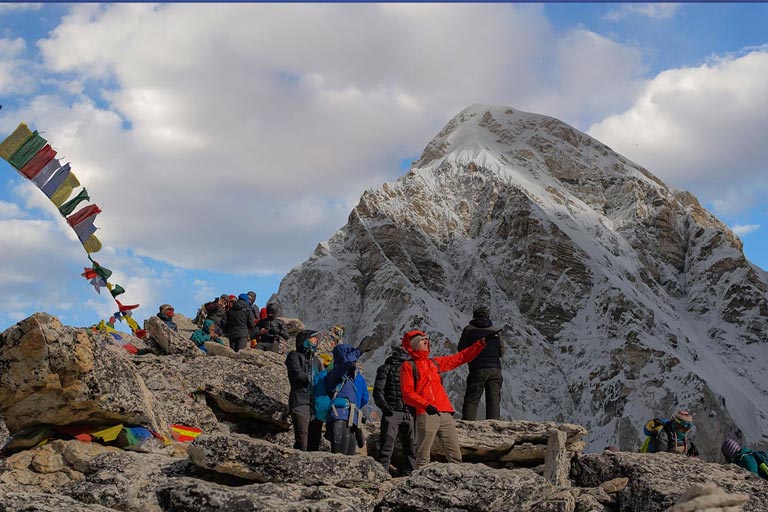
And then you’ll stand at 5,364m/17,599ft , looking at the Khumbu Glacier sprawling toward the base of the world’s highest mountain, with prayer flags snapping in the Himalayan wind, and every one of those hard days will make complete sense. They were the price of admission to somewhere extraordinary. And you paid it.
Dr. David McClung, at 82, paid it. With the right guide, the right preparation, and the right mindset so can you.
We’ve been running EBC treks since 1992. Our team has guided first-time trekkers nervous, uncertain, altitude-anxious to Base Camp and back, with a zero-death safety record that spans over three decades. If you want to talk through your fitness level, any medical concerns, or which itinerary is right for you, our specialists are ready. No pressure, no sales script. Just 34 years of knowledge, honestly shared.
Ready to Start Planning?
Talk to a Himalayan Glacier destination specialist about your EBC trek. We’ll help you build an itinerary matched to your fitness level, timeline, and budget and prepare you properly for the mountain.