

Small group expeditions improve Himalayan treks by keeping group size low enough for a guide to monitor every trekker for altitude sickness, adjust pace day by day, and access quieter teahouses and villages. Himalayan Glacier caps its small group departures at 12 trekkers. Couples and travelers who need full control over dates and route are usually better served by a private trek.
A guided trek above the Khumbu Valley feels very different with 8 people than with 25. Group size shapes how closely guides watch for altitude symptoms, how flexible the itinerary can be, and how much time there is for tea with a Sherpa family in Tengboche.
Small group expeditions, typically capped at 12 participants, have become the preferred format for first-time trekkers and solo travelers who want depth over volume. This guide explains how the format works, how it improves safety, social connection and environmental impact, which routes suit it best, and when a private trip is the stronger choice.
Key Takeaways
- Small group expeditions in the Himalayas usually run with 4 to 12 trekkers. Himalayan Glacier caps groups at 12.
- Smaller groups let guides check each trekker for altitude sickness, hydration and fatigue several times a day.
- Fewer people means more itinerary flexibility, such as adding an acclimatization day above 3,500m / 11,483ft.
- Small teams fit into family-run teahouses and quieter villages that large tours often bypass.
- Private treks suit couples, families with specific needs and travelers who want a fully custom route.
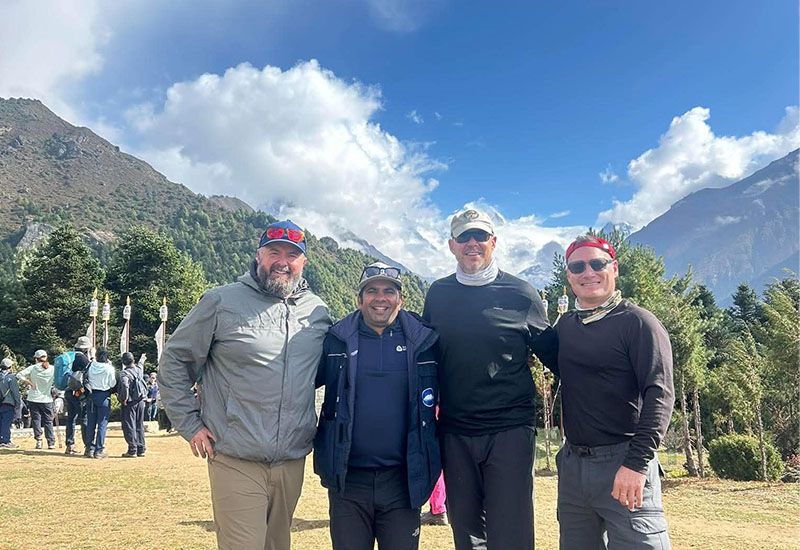
What Is a Small Group Expedition in the Himalayas?
A small group expedition is a guided trek with a capped number of participants, usually between 4 and 12 trekkers, who share a fixed departure date and route. Licensed local guides, porters and support staff handle permits, logistics and teahouse bookings.
Large commercial tours can carry 20 or more travelers. Small groups move through trails with less congestion and can adapt faster. If the group needs an extra rest day above 3,500m / 11,483ft, the guide can rearrange the schedule. If snow closes a pass, a smaller team can switch to an alternative route with less coordination.
Does Nepal require a guide for small group treks?
Yes. Since April 2023, foreign trekkers on most major routes in Nepal must trek with a licensed guide and carry a TIMS card issued through the Nepal Tourism Board. The rule covers the Everest, Annapurna, Langtang and Manaslu regions. A registered operator arranges these documents as part of the trip.
| Format | Typical Size | Departure | Best For |
| Small group expedition | 4 to 12 trekkers | Fixed dates | Solo travelers, first-timers, budget-conscious trekkers |
| Private trek | 1 to a few travelers | Any date | Couples, families, custom routes, special needs |
| Large commercial tour | 20+ trekkers | Fixed dates | Lowest per-person cost, less flexibility |
How Does Group Size Affect Safety on Himalayan Treks?
Smaller groups are safer because guides can spot altitude sickness, dehydration and exhaustion early in each individual trekker. Early detection is the single most important safety factor above 3,000m / 9,843ft.
Acute mountain sickness does not follow fitness. A marathon runner can struggle at Lobuche while a moderately fit hiker feels fine. Symptoms such as headache, nausea and poor sleep need to be noticed and acted on within hours, not days.
What can a guide monitor in a group of 12 or fewer?
- Breathing and pace on steep climbs, such as the ascent from Phakding to Namche Bazaar at 3,440m / 11,286ft
- Appetite, fluid intake and sleep quality reported at the teahouse each evening
- Early altitude symptoms, so a trekker can rest, descend or adjust pace before symptoms escalate
- Who is falling behind, so the group can regroup instead of spreading out over kilometers of trail
On the Everest Base Camp Trek, the highest point is Kala Patthar at 5,545m / 18,192ft, with Base Camp itself at 5,364m / 17,598ft. Himalayan Glacier runs this 14-day trip in groups of up to 12 and reports a 98% success rate on the route.
In Nepal’s restricted areas, a March 2026 rule update allows one licensed guide to lead up to seven trekkers, which reinforces the small group model on routes such as Manaslu and Tsum Valley.
Expert Insight Himalayan Glacier’s guides note that the most dangerous moment on a high-altitude trek is when a trekker hides symptoms to avoid slowing the group. In a small group, guides know each person well enough to notice changes in mood, appetite and pace, and to raise the issue early.
Limited Spring Departures for Everest Base Camp
Our spring small group departures fill early, and each one is capped at 12 trekkers. Reserve a seat now and walk to Kala Patthar with a guide who knows every person on the team.
Check EBC Dates ➝
Why Do Small Groups Create Stronger Social Connections on the Trail?
Small groups of 6 to 12 trekkers bond faster because everyone shares the same meals, pace and daily challenges. Names are learned on the first day, and by the second week the group functions like a team.
The shared rhythm is simple: an early start, hours of walking, dal bhat in a teahouse kitchen, and conversation around the dining room stove. That routine builds camaraderie that large tours rarely achieve.
Is a small group trek good for solo travelers?
Yes. Solo travelers are one of the biggest beneficiaries of small group expeditions. They get built-in company, shared costs and a guide, without the isolation of a 25-person crowd. Many arrive alone and leave with friendships formed over sunrise at Kala Patthar or evenings in Tengboche.
Do small groups work for families?
Small groups give families room to move at a comfortable pace. Guides have the bandwidth to point out Himalayan wildlife, explain Sherpa and Tamang traditions, and shorten a walking day when younger or older members tire. Families with very young children or specific needs often choose a private trek instead.
Which Himalayan Routes Are Best for Small Group Expeditions?
Almost every classic Himalayan route suits small group trekking, and the format adds the most value on routes with limited lodging or permit restrictions. The table below compares current Himalayan Glacier departures.
| Trip | Duration |
| Everest Base Camp Trek | 14 days |
| Annapurna Base Camp Trek | 11 days |
| Manaslu Circuit Trek | 14 days |
| Langtang Valley Trek | 11 days |
| Bhutan Tour with Day Hikes | 6 days |
| Luxury Kailash Mansarovar Yatra | 13 days |
Annapurna Base Camp: the best introduction
The 11-day Annapurna Base Camp Trek is one of the most accessible options for first-time trekkers. Teahouses line the route through Gurung and Magar villages such as Chhomrong, and the high point of 4,130m / 13,551ft is moderate by Himalayan standards. A small group has time to stop in these villages rather than rushing between lodges.
Manaslu Circuit: remote and permit-controlled
The 14-day Manaslu Circuit is a restricted-area trek that crosses Larkya La at 5,106m / 16,752ft. It requires a Restricted Area Permit plus MCAP and ACAP conservation permits, all arranged through a registered agency with a licensed guide. Far fewer trekkers walk this route than Everest or Annapurna, so campsites and teahouses along the Budhi Gandaki gorge stay quiet.
Since March 2026, Nepal’s Department of Immigration no longer requires a minimum of two trekkers for restricted-area permits. Solo trekkers can now apply, though a licensed guide is still mandatory.
Langtang Valley: short on time, big on views
The 11-day Langtang Valley Trek starts a short drive north of Kathmandu and reaches Tserko Ri at 5,000m / 16,405ft. It suits trekkers with limited vacation time who still want glacier views and Tamang village culture.
Beyond Nepal: Bhutan and Mount Kailash
The small group principle extends across the wider Himalaya. Bhutan day-hiking tours pair dzongs and monasteries with short guided hikes, while the Kailash Mansarovar Yatra in Tibet circles the sacred mountain over Dolma La at 5,650m / 18,538ft. Both benefit from guides who can manage permits, pacing and altitude for a small team.
How Do Small Group Expeditions Reduce Environmental Impact?
Small groups put less pressure on fragile trails, water sources and teahouses, and make responsible waste handling practical. A group of 8 generates far less waste than a group of 25.
- Lower trail erosion on narrow, high-traffic sections during peak season
- Waste that porters can realistically carry out rather than leave at high camps
- Use of family-run teahouses, which keeps tourism income in Sherpa, Gurung and Tamang communities
- Easier enforcement of leave-no-trace habits, because a guide can see and speak with every trekker
Himalayan Glacier is listed as a Leave No Trace Certified Partner, and its operations team and guides are employed through its own Kathmandu office. That structure supports consistent trail standards from one departure to the next.
When Should Travelers Choose a Private Trek Instead of a Small Group?
A private trek is the better choice when travelers need full control over dates, pace, route or privacy. Couples, families with specific needs and travelers combining multiple regions most often choose private.
| Factor | Small Group Expedition | Private Trek |
| Dates | Fixed departures | Any date that suits the traveler |
| Pace | Set for the group, adjusted by the guide | Set entirely by the traveler |
| Route changes | Limited to safety or weather | Fully customizable |
| Social experience | Built-in trail companions | Privacy for couples or families |
| Cost | Shared logistics, lower per-person cost | Higher per-person cost for small parties |
| Best for | Solo travelers, first-timers | Honeymooners, families, special dietary or mobility needs |
A good example is the 18-day Everest Base Camp via Gokyo Lakes and Cho La Pass route, from US$3,590. Run privately, it can be tailored day by day, with extra rest at Gokyo or a slower crossing of Cho La at 5,420m / 17,782ft.
Himalayan Glacier describes itself as a family-owned specialist in private and small group travel. Both formats use the same guides, porters and operating standards, which matters when trekkers depend on the people beside them at 5,000m / 16,404ft.
How Should Trekkers Prepare for a Small Group Himalayan Trek?
Preparation should start at least three months before departure, with cardio training, altitude awareness and the right layered gear. A well-prepared trekker keeps the whole group on schedule.
- Train for sustained uphill effort. Hike hilly terrain with a loaded daypack 2 to 3 times a week. Himalayan trekking days are measured in hours on foot, often 5 to 7, rather than distance.
- Learn the signs of altitude sickness. Headache, nausea, dizziness and poor sleep should be reported to the guide immediately.
- Discuss health and fitness with the operator early. Share medical history and concerns before booking, not at the trailhead.
- Pack layers for a wide temperature range. Valley floors can be warm, while nights above 4,500m / 14,764ft drop below freezing.
- Check what gear is included. On the Annapurna Base Camp Trek, Himalayan Glacier includes a down jacket and sleeping bag on loan, plus a duffel bag for porters.
Packing Tip Break in trekking boots on several long training hikes before departure. New boots and blisters are a common reason trekkers slow down in the first days on the trail, when the group is still finding its rhythm.
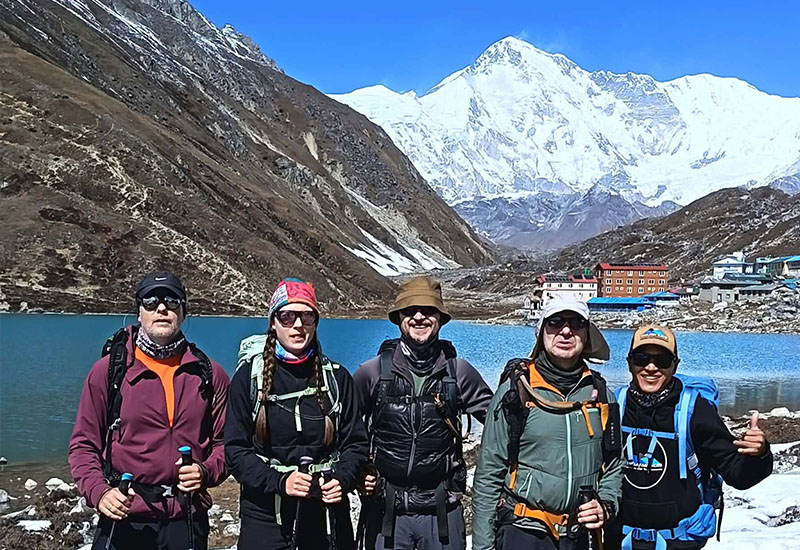
What Is the Best Season for Small Group Trekking in the Himalayas?
Spring (March to May) and autumn (September to November) are the best seasons for small group trekking in Nepal. Both offer stable weather and clear mountain views.
| Season | Months | Conditions | Small Group Notes |
| Spring | March to May | Mild days, rhododendron blooms below 3,500m / 11,483ft | Popular; book EBC departures early |
| Autumn | September to November | Clearest skies, sharp mountain views | Peak season; October is busiest |
| Winter | December to February | Cold, snow can close high passes | Fewer groups; suited to lower routes |
| Monsoon | June to August | Rain, landslide risk, poor visibility | Generally avoided on most routes |
Trek the Himalayas with a Team You Can Trust
Since 1992, we have guided travelers across Nepal, Tibet and Bhutan, with a 4.8 TripAdvisor rating from 500+ reviews. Our US office in Baltimore, MD handles booking and support, and our Kathmandu team runs every trek on the ground.
Is a Small Group Expedition the Right Format?
For most first-time Himalayan trekkers and solo travelers, small group expeditions offer the best balance of safety, social energy and cost. A 12-person cap keeps guides close to every trekker while keeping the itinerary flexible.
Couples and families who want privacy or a fully custom route will find more freedom in a private trek, with the same guides and standards. Himalayan Glacier has run both formats since 1992, combining on-ground Nepal expertise with US-based support for international travelers.
FAQs About Small Group Himalayan Expeditions
A small group Himalayan trek usually has 4 to 12 participants. Himalayan Glacier caps its small group departures at 12 trekkers, which keeps guide attention personal and the pace flexible.
For most first-time and solo trekkers, yes. A small group offers closer guide monitoring for altitude sickness, shared costs and built-in company, while large tours dilute guide attention.
Yes. Foreign trekkers on most major Nepal routes must already hire a licensed guide, and a small group adds shared vigilance and faster emergency coordination on top of that.
Yes. Solo travelers regularly join scheduled small group departures. Since March 2026, solo trekkers can also obtain restricted-area permits for routes like Manaslu, as long as they trek with a licensed guide.
A small group trek follows a fixed departure date shared with other travelers. A private trek is built entirely around one party’s dates, pace and route. Himalayan Glacier runs both with the same team.
Spring, from March to May, and autumn, from September to November, offer the clearest skies and most stable trail conditions. October is the busiest single month.
Start Planning a Himalayan Trek, Stress-Free
Tell us your dates and fitness level, and we will match you with the right group departure or a private itinerary. No-obligation advice from our US and Kathmandu teams.


