

Mount Everest, the highest peak in the world, is popularly known as Sagarmatha (Goddess of the Sky) in Nepal and Chomolungma (Mother Goddess of the World) in Tibet. It is located at 8,848.86m/29,031.69ft. on the border of Nepal and Tibet. it’s not just naturally beautiful but also filled with history, mystery, and deep cultural importance. This magnificent peak is part of the Mahalangur Himalayan sub-range and represents challenge, adventure, and unwavering human spirit.
Mount Everest has attracted climbers from all over the world for decades. The first people to climb it were Sir Edmund Hillary and Tenzing Norgay in 1953. Since then, many have attempted to follow in their footsteps. Climbers can climb Mount Everest through two distinct routes: from Nepal through the Solukhumbu and Sagarmatha National Parks. At the same time, it is accessible from the Tibetan side through the Tingri Country in the Xigazê region.
- 1. How was Mount Everest Formed?
- 2. Location and Geography of Mount Everest
- 3. Where is Mount Everest Located Nepal or China?
- 4. Where is Mount Everest on the World Map?
- 5. Cultural and Religious Significance of Mount Everest
- 6. The History of Mount Everest Climbing
- 7. How to Access Mount Everest Routes?
- 8. Mount Everest Base Camps
- 9. Popular Trekking Trails to Everest
- 10. Environmental Challenges and Conservation Efforts
- 11. Interesting Facts about Mount Everest
1. How was Mount Everest Formed?
The highest point of the Himalayan mountain range along with Mount Everest was formed millions of years ago when the Indian and Eurasian tectonic plates collided. The Indian plate started moving northward about 50 million years ago towards the Eurasian plate at a rate of a few millimeters yearly. This slow process caused the Indian plate to collapse into the Eurasian plate through a Subduction.
This collision created enormous pressure and friction, forcing the land to buckle and fold, which pushed up sedimentary rock layers to form towering mountain ranges. Over millions of years, this geological activity formed the Himalayas, with Mount Everest as the highest peak. The formation of Mount Everest continues to rise by a few millimeters each year due to persistent tectonic activities.
2. Location and Geography of Mount Everest
Mount Everest is located in the Mahalangur Himal sub-range, on the border of Nepal and Tibet. Its geographical coordinates are 27.9881° N latitude and 86.9250° E longitude. Mount Everest is located on both the Nepal and Tibet sides. On the Nepal side, it is situated in the Sagarmatha National Park, a UNESCO World Heritage site in the Khumbu region.
The mountain is widely recognized for its towering peaks and adventurous climbing conditions. It is covered with high-altitude plateaus, deep valleys, steep, untamed landscapes, and various glaciers. Despite the harsh conditions, the Everest region is home to diverse flora, fauna, and rare wildlife.
3. Where is Mount Everest Located Nepal or China?
Mount Everest is located in the Solukhumbu of everest region in Nepal. However, the peak is shared across the border of Nepal and Tibet (the autonomous region of China). The peak is situated at 8,848.86m/29,031.7ft above sea level and touches the both country from the southern and northern sides. The southern side, recognized as the southeast ridge, lies on the Nepal side of the Sagarmatha National Park within the Solukhumbu district. Moreover, this is where most climbers begin their ascent starting from the Lukla to the remarkable Everest Base Camp Trek.
Similarly, the northern side, known as a northeast ridge, lies in the Tingri city of Tibet. This route is less used by climbers and less crowded in comparison with the Nepal side. Even though it’s less known, it still holds huge cultural and historical significance for the Tibetan people. Thus, the Everest location is uniquely divided between Nepal and Tibet, which has united the two different nations and cultures.

Location of Mount Everest on the World Map
4. Where is Mount Everest on the World Map?
On a world map, we can find Mount everest located in South Asia between the latitudes of 27.9881° and longitudes of 86.9250° E. Its southern face lies on Nepal and its northern face lies on the Tibet side. If we look at the world map, Everest lies on the northeast of Kathmandu (the capital city of Nepal) and southwest of Lhasa (the capital city of Tibet). This majestic peak is part of the Mahalangur Himalayan ranges which covers five nations including Bhutan, China, India, Pakistan, and Nepal.
5. Cultural and Religious Significance of Mount Everest
Mount Everest holds the deepest cultural and spiritual significance, especially for the Indigenous Sherpa community in the Everest region. Everest is a sacred site to the Sherpa people, as they revere the peak as the home of the special deities. It is also believed that climbing a mountain is a spiritual journey that requires blessings and ceremonies to please god, rather than just focusing on physical strength.
Along with the Sherpa community of the everest region, the peak is also a symbol of spiritual elevation and human achievement worldwide. The Hindu and Buddhist communities often considered mountains an emblem of the axis mundi, or the globe’s center that connects heaven and earth. Mount Everest is often seen as a place for reflection, growth, and spiritual growth. It also symbolizes overcoming challenges and obstacles, aiming for greatness, and connecting with something higher.
6. The History of Mount Everest Climbing
The history of Mount Everest climbing is a saga of human courage, inspiration, and strength. The climbing journey first began with the early reconnaissance mission in the 1920s by the British Team. The expedition became worldwide recognizable when Sir Edmund Hillary and Tenzing Norgay Sherpa completed the summit successfully on May 29, 1953.
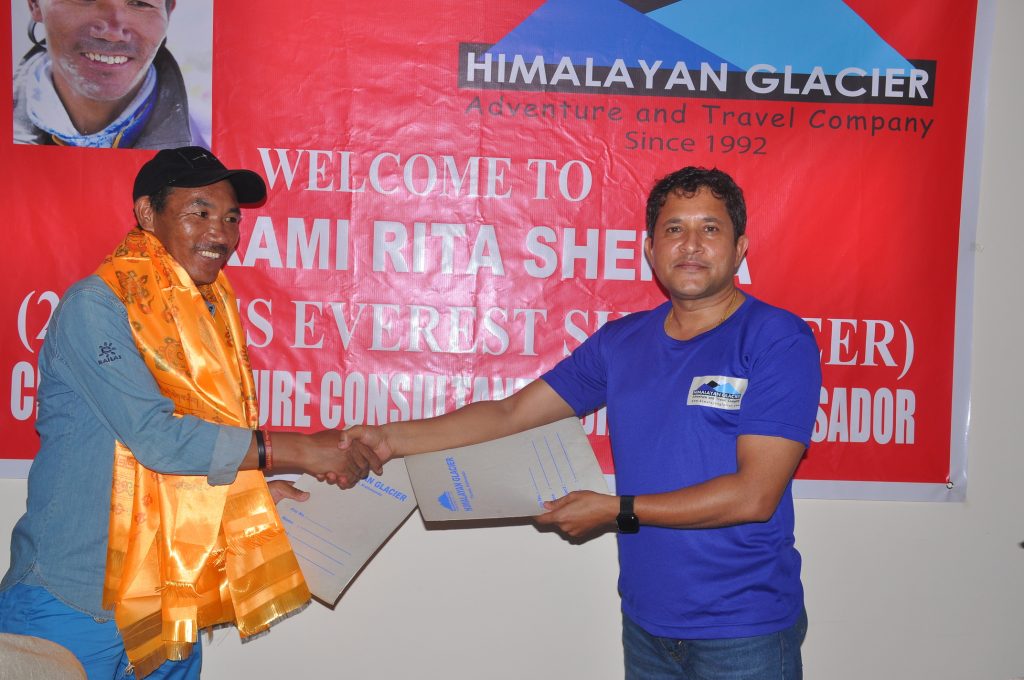
Moment of Kami Rita Sherpa and Company CEO Sagar Pandey Signed a Treaty
Some of the list of the milestones in the Everest expedition history are:
| Year | Achievement | Climber’s name |
| 1953 | First successful summit | Sir Edmund Hillary and Tenzing Norgay |
| 1975 | The first woman to summit | Junko Tabei |
| 1978 | First ascent without supplemental oxygen | Reinhold Messner & Peter Habeler |
| 1988 | First woman to summit without oxygen | Lydia Bradey |
| 1993 | First Nepalese women to summit | Pasang Lhambu Sherpa |
| 1999 | Discovery of George Mallory’s body, who disappeared in 1924 | Conrad Anker and Eric Simonson’s team |
| 2000 | Record for the longest stay at the summit (21 hours) | Babu Chiri Sherpa |
| 2001 | First blind person to reach the summit | Erik Weihenmayer |
| 2008 | Record for the fastest ascent (8 hours, 10 minutes) | Pemba Dorje Sherpa |
| 2010 | The youngest person to reach the summit (age 13) | Jordan Romeo |
| 2016 | First American woman to summit without oxygen | Melissa Arnot |
| 2023 | Record for climbing Mount Everest for 27th time on May 22, 2023 | Pasang Dawa Sherpa |
| 2023 | First Indian female twins to summit everest | Tashi and Nungshi Malik |
| 2024 | Most summits by an individual (30 times) on May 22, 2024 | Kami Rita Sherpa |
7. How to Access Mount Everest Routes?
Mount Everest can be accessed from both the Nepal and Tibet sides. It has several routes for climbers, the most popular of which are South Col( Nepal’s side) and North Col(Tibet’s side). However, the most popular route is considered from the Nepal side.
Southeast Ridge (Nepal):
The southeast ridge is the most popular route, and it was first successfully conquered by Sir Edmund Hillary and Tenzing Norgay on May 29, 1953. The expedition starts from Nepal’s Everest Base Camp (5,346m/17,598ft). From the base camp, climbers continue toward the Khumbu Icefall (a hazardous glacier in the everest region), to Camp I. Continuing from there, they navigate the Western cwm(glacial valley below Mount Everest and Mount Nuptse) to Camp II.
The routes proceed toward Camp III through the Lhotse face to Camp IV to the South Col. South Col is the last camp before the summit. The last ascent includes passing the Southeast ridge and Hillary step. Hillary’s step is the 12-meter rock face below the summit, before reaching the highest point.
Northeast Ridge(Tibet):
It is another popular route, starting from the north side of the everest in Tibet. Climbers start their journey from the North Base Camp(5,150m/16,900ft). They follow the route through the Rongbuk Glacier to reach Advanced Base Camp. From there they pass through high camps that include North Col(7,000m/23,000ft) and Camp IV. The ascent includes steep, challenging rock sections known as the First, Second, and Third Steps, which require technical climbing skills. This route is colder and windier than the Southeast Ridge.
Are you ready to explore the everest region?
The Everest Base Camp trek provides an adventurous and rewarding experience through stunning Himalayan landscapes, rich Sherpa culture, and breathtaking views of the world’s highest peaks.
8. Mount Everest Base Camps

Two main base camps serve as the starting point for these climbing expeditions. The South Base Camp is located in the everest region of Nepal within the Sagarmatha National Park. It is located at an altitude of 5,364m/17, 598ft. The route is accessible via a trek from Lukla. The everest base camp trek duration typically takes 10 to 15 days allowing climbers and trekkers to acclimatize to high elevation. Further, the trek passes through major destinations including Namche Bazaar, Tengboche, Dingboche, and Gorakshep.
Similarly, the North Base Camp (5,150m/16,900ft) is located in the Tingri country within Tibet (an autonomous region of China). Unlike the South Base Camp, it is easily accessible through vehicles and roads crossing from Lhasa and Shigatse. The North Base Camp is less crowded than the South one and more challenging.
9. Popular Trekking Trails to Everest
There are many trekking routes to reach Everest. Each of the trails provides a rewarding and adventurous experience. Some of the most popular trekking trails to Everest are listed below:
| Popular Trekking Trails to Everest | Duration |
| Everest Base Camp Trek | 14 or 16 Days |
| Everest Three passes Trek | 20 Days |
| Everest Base Camp Luxury Trek | 15 Days |
| Everest Base Camp Trek via Gokyo Lake and Cho la pass | 18 Days |
| Everest View Trek | 7 Days |
| Everest Base Camp Trek: Return by Heli | 12 Days |
Check out more details about the popular trekking trails to everest, explore various scenic routes, and choose the best trails for your himalayan adventure.
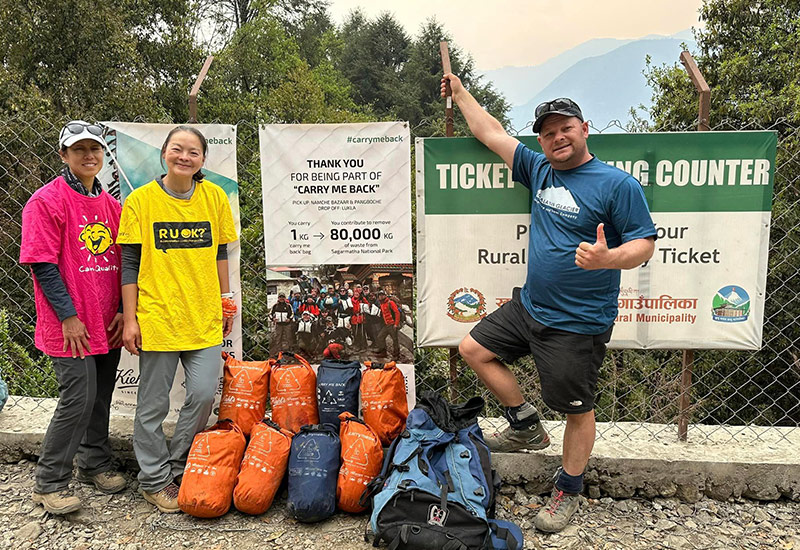
Our guests are carrying back their waste to ensure no trash is left on the Everest trail.
10. Environmental Challenges and Conservation Efforts
Mount Everest has faced several environmental challenges including waste management, glacial bursts, overcrowding, and natural hazards like avalanches and rockfalls. Climbers leave behind garbage like discarded climbing gear, food wrappers, and human waste, directly affecting the mountain’s beauty and ecological system. Additionally, melting glaciers and hazards such as avalanches or rockfalls can pose a risk to climbers, locals, and the environment.
Different conservative efforts are made to reduce this problem. Both Nepal and Tibet organize yearly waste clean-up campaigns. This program is organized by different authorities, including the Sagarmatha Pollution Control Committee(SPCC), the Everest Summiteers Association, the Nepal Mountaineering Association, and many other groups that aim to combat accumulated waste. Similarly, authorities have raised awareness regarding globalization and climate change and encouraged sustainable practices to reduce carbon emissions.
Some of the lists of organizations that have focused on waste collection and environmental sustainability are listed below:
| Organizations | Waste Collections |
| Sagarmatha Pollution Control Committee(SPCC) | Collected about 85 tons of garbage from Everest Base Camp during the Spring 2024 climbing season |
| Nepal Army and Unilever Nepal | Collected over 13 tons of waste from Mount Everest in 2023 |
| Nepal Army as a part of the Clean Mountain Campaign | Collected 14 tons of garbage in 2022 |
| Nepal Army and Non-governmental bodies | Collected 2 tons of garbage in 2019 |
| Everest Clean Up Campaign | Different airlines collected over 38 tons of garbages in 2018 |
11. Interesting Facts about Mount Everest
Some of the interesting facts about the Mount Everest are listed below:
- Mount Everest is the tallest peak in the world, perched at an elevation of 8,846.86m/29,031.7ft.
- It is popularly known as “Sagarmatha” in Nepal and “Chomolungma” in Tibet.
- The peak was formed by the collision of the Indian and Eurasian tectonic plates.
- The first successful summit was done by Sir Edmund Hillary and Tenzing Norgay on May 29, 1953.
- The two main routes for the everest expedition are the Southeast ridge from Nepal and the Northeast ridge from Tibet.
- The area above 8,000 meters is considered a Death zone due to extremely low oxygen.
- Due to tectonic activities, everest height changes by over 0.16 inches every year.
In conclusion, Mount Everest stands as a remarkable natural wonder that continues to inspire and captivate adventurers from around the globe. It represents not only the awe-inspiring beauty of nature but also the indomitable spirit of human achievement and resilience.
Let’s plan your trip and experience the breathtaking beauty of the Himalayas. Journey to Everest Base Camp is more than just a trek—it’s a personal challenge and a once-in-a-lifetime adventure waiting for you!


