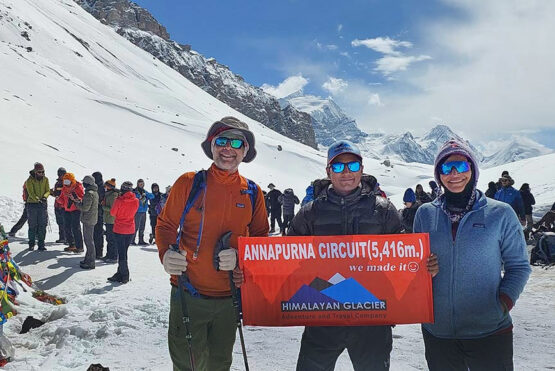
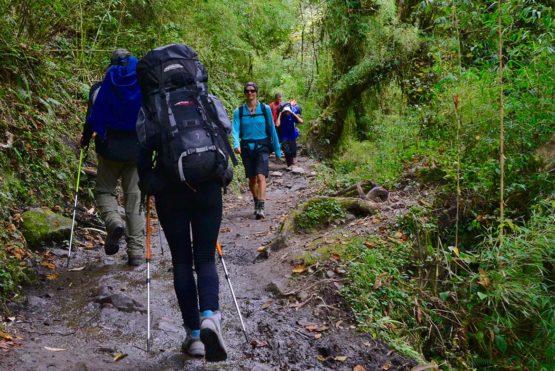
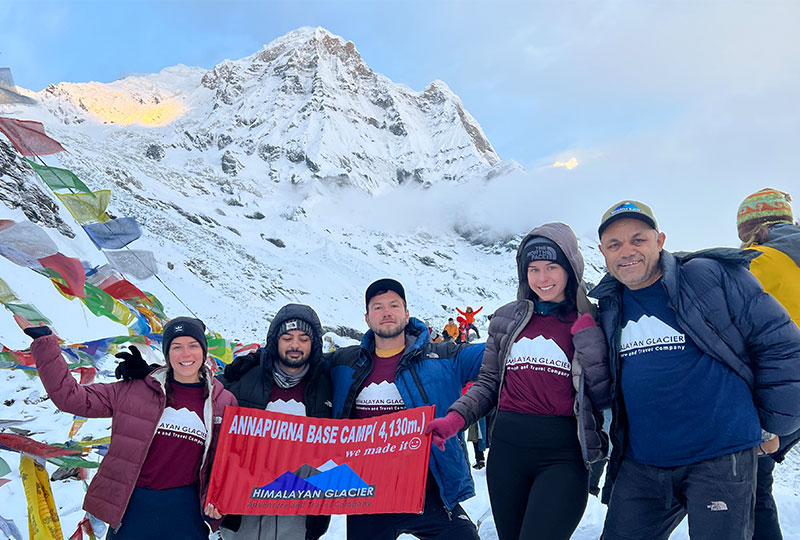
Annapurna Base Camp (ABC) suits trekkers with 11 to 14 days who want maximum Himalayan scenery in minimum time, reaching 4,130m/13,549ft inside a dramatic amphitheater of peaks. The Annapurna Circuit suits trekkers with about three weeks who want a longer, more varied journey around the entire Annapurna massif, crossing Thorong La Pass at 5,416m/17,769ft. ABC is shorter, gentler, and less expensive. The Circuit is longer, harder, and reaches a higher, more demanding pass, but rewards trekkers with greater cultural and geographic variety.
Annapurna is Nepal’s most trekked region, and “Annapurna” means two very different products to two very different travelers. Annapurna Base Camp (ABC) delivers a concentrated dose of high-mountain scenery in under two weeks. The Annapurna Circuit circles the entire Annapurna massif over roughly three weeks, trading speed for range and altitude. Neither trek is objectively “better”; the right choice depends on available time, fitness, and what kind of Himalayan experience a traveler is seeking.
How Many Days Does the Annapurna Circuit Take Compared to ABC?
The Annapurna Circuit takes roughly twice as long as Annapurna Base Camp. Himalayan Glacier’s standard Annapurna Base Camp Trek runs 11 days, while its classic Annapurna Circuit Trek runs 17 days, with a shorter 14-day version (Annapurna Circle Trek) available for trekkers who want the Circuit’s terrain without the full three-week commitment.
| Trek Option | Typical Duration | Trailhead | Maximum Altitude |
| Annapurna Base Camp (short route) | 7 to 9 days | Pokhara / Nayapul | 4,130m / 13,549ft |
| Annapurna Base Camp Trek | 11 days | Pokhara / Ghandruk | 4,130m / 13,549ft |
| Annapurna Sanctuary Trek (relaxed pace) | 14 days | Pokhara / Ghandruk | 4,130m / 13,549ft |
| Annapurna Circle Trek (shorter Circuit) | 14 days | Besisahar | 5,416m / 17,769ft |
| Annapurna Circuit Trek (classic, full route) | 17 days | Besisahar | 5,416m / 17,769ft |
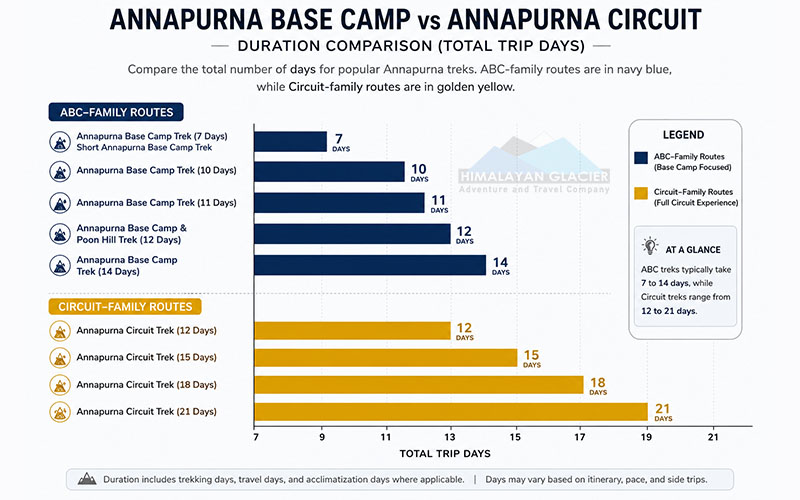
All itineraries begin in Kathmandu at 1,350m/4,429ft before transferring toward the trailhead. Trekkers with a single week to spare gravitate toward the short ABC route; those planning their one big annual trip around a three-week Himalayan holiday are the natural audience for the full Circuit.
Is the Annapurna Circuit Harder Than Annapurna Base Camp?
Yes. Himalayan Glacier’s own trip data and guide feedback rank the Annapurna Circuit as harder and longer in duration than Annapurna Base Camp, primarily because of the altitude at Thorong La Pass (5,416m/17,769ft) and the greater total walking distance.
ABC tops out at 4,130m/13,549ft and begins from a lower base altitude, which allows for more gradual acclimatization. The trail also passes through lower-altitude rhododendron forest for a larger share of the route, keeping oxygen levels comparatively higher for longer. Both treks still require a similar baseline of physical fitness, since daily walking hours are comparable even though ABC’s overall altitude exposure is lower.
Himalayan Glacier’s guides note that the Thorong La crossing is considered challenging mainly because of altitude and the length of the summit day, not technical climbing skill. Trekkers typically wake at 3:00 to 4:00 a.m. at High Camp (4,850m/15,912ft) or Thorong Phedi (4,450m/14,600ft) to begin the ascent in the dark, when temperatures are coldest but winds are calmest.
Weather adds a further difficulty gap: The Annapurna Circuit route usually closes during winter because of heavy snow accumulation at Thorong La, while ABC’s lower elevation keeps it accessible across a wider seasonal window.
| Factor | Annapurna Base Camp | Annapurna Circuit |
| Maximum altitude | 4,130m / 13,549ft | 5,416m / 17,769ft |
| Daily walking hours | 5 to 6 hours | 5 to 7 hours |
| Winter access | Generally accessible | Route typically closed |
| Relative difficulty | Easier, more forgiving | Harder, longer |
Which Trek Has Better Mountain Views, ABC or the Circuit?
Both treks deliver exceptional Himalayan scenery, but in different forms. ABC concentrates its views into a dramatic amphitheater at the base camp itself, while the Circuit spreads a wider variety of landscapes across three weeks of trail.
Annapurna Base Camp
A 360-degree amphitheater setting at 4,130m/13,549ft, ringed by Annapurna I (8,091m/26,545ft), Annapurna South (7,219m/23,684ft), Machapuchhre (6,993m/22,943ft), and Hiunchuli (6,441m/21,132ft), plus a Poon Hill sunrise over the Annapurna and Dhaulagiri ranges.

Annapurna Circuit
Views of Annapurna II, III, and IV, Manaslu, Gangapurna, and Dhaulagiri I (8,167m/26,795ft), plus the Kali Gandaki Gorge, the world’s deepest gorge, and an optional side trip to Tilicho Lake, one of the highest lakes in the world.
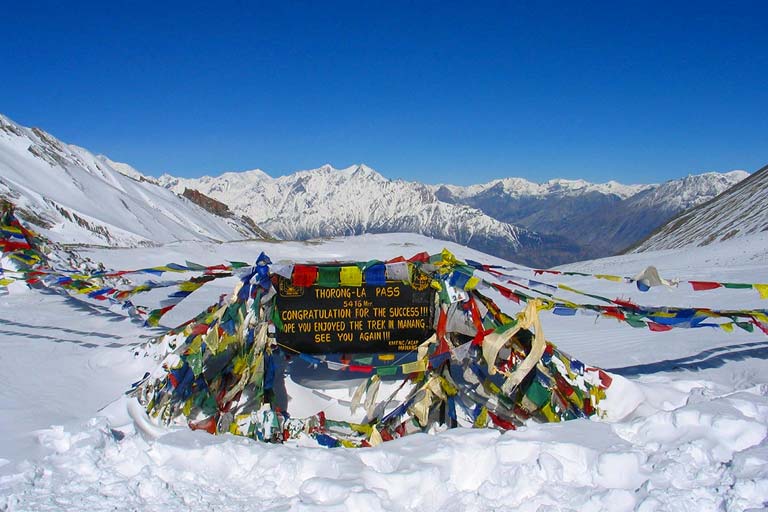
Trekkers prioritizing a single, unforgettable mountain panorama in the shortest possible time tend to prefer ABC. Trekkers who want geographic range, from subtropical valleys to high alpine desert, tend to prefer the Circuit.
Which Is Cheaper, ABC or the Annapurna Circuit?
Annapurna Base Camp is the less expensive trek overall, mainly because its shorter itinerary means fewer paid trekking days, fewer permit-linked fees, and less guide and porter time. The Annapurna Circuit costs more because its 17-day classic itinerary covers roughly double the trail days of ABC.
For exact current pricing on Annapurna Base Camp, see the Annapurna Base Camp Trek and contact Himalayan Glacier directly, since published rates vary by season, group size, and departure date.
A fully guided, fully supported Annapurna Circuit trek with Himalayan Glacier, including logistics, permits, and professional guide and porter support, typically runs approximately $2,900 to $3,1060 per person, depending on trip duration and group size.
Both treks share two mandatory fees regardless of route: the Annapurna Conservation Area Permit (ACAP), priced at approximately NPR 3,000 (about $25 to $30) for non-SAARC nationals and NPR 1,000 for SAARC nationals, and the cost of a government-licensed guide, which trekking agencies typically build into an all-inclusive package rather than charging separately.


What Permits and Guide Rules Apply in 2026?
Both Annapurna Base Camp and the Annapurna Circuit require the Annapurna Conservation Area Permit (ACAP) and a government-licensed guide booked through a registered trekking agency. The Trekkers’ Information Management System (TIMS) card is not currently compulsory or actively enforced on Annapurna routes as of 2026, though trekking authorities have proposed reinstating it nationwide, so its status is worth reconfirming close to a booking date.
- ACAP (Annapurna Conservation Area Permit): mandatory for both treks, approximately NPR 3,000 / $25–$30 for non-SAARC nationals.
- Licensed Guide: mandatory for both treks under Nepal’s April 2023 rule requiring a government-licensed guide from a TAAN-registered agency; checkpoint enforcement has been consistent across Annapurna routes as of 2026.
- TIMS Card: not currently compulsory or enforced on Annapurna routes as of 2026; travelers should confirm current status with their trekking agency before departure, since this is one of the more fluid rules in Nepali trekking regulation.
Limited Spring 2027 Annapurna Departures Remaining
Spring is the most requested season for Annapurna Base Camp, and group departures fill first. Reserve a spot now to lock in March-through-May trail conditions and the clearest mountain views of the year.
Check Spring Dates →
Which Trek Fits Your Travel Style?
The clearest way to choose between ABC and the Annapurna Circuit is to start from the traveler, not the trail statistics.
Annapurna Base Camp fits travelers who:
- Have 7 to 14 days total in Nepal and want to maximize scenery within that window.
- Are taking their first Himalayan trek and want a moderate, well-supported introduction.
- Want a single, concentrated mountain payoff rather than a long journey.
- Prefer a shorter financial and physical commitment.
The Annapurna Circuit fits travelers who:
- Have three weeks or more and want an immersive, multi-region Himalayan journey.
- Want the variety of subtropical valleys, high desert, and the Kali Gandaki Gorge in one trip.
- Want to say they crossed one of the highest trekking passes in the world at Thorong La.
- Have already completed a shorter Himalayan trek and are ready for a longer, harder route.
Can Beginners Do the Annapurna Circuit?
Beginners can complete the Annapurna Circuit with adequate physical preparation, but it is a longer and harder trek than Annapurna Base Camp, and first-time trekkers with limited time are usually better served starting with ABC. Trekkers who choose the Circuit as a first Himalayan trek should train for several months beforehand and build in extra acclimatization days around Manang before attempting the Thorong La crossing.
Trek With a Feefo-Verified, Nepal-Based Operator
Himalayan Glacier has operated on-ground in Nepal since 1992 and is reviewed on Feefo, an invitation-only, verified review platform, so every review comes from a real past client.
A US-based support office in Baltimore, MD, handles booking and customer support alongside the Kathmandu operations team.
ABC vs Annapurna Circuit: Quick Comparison
| Factor | Annapurna Base Camp | Annapurna Circuit |
| Typical duration | 11 days (7–14 day range) | 17 days |
| Maximum altitude | 4,130m / 13,551ft | 5,416m / 17,770ft |
| Difficulty | Moderate | Moderate to challenging |
| Signature feature | 360° base camp panoramic mountain view | Thorong La Pass, Kali Gandaki Gorge, Tilicho Lake option |
| Guided cost (Himalayan Glacier) | Approximately $2499 | Approximately $3,160 |
| Best for | First-timers, limited time, scenery-focused travelers | Experienced or well-prepared trekkers wanting immersion and variety |
Frequently Asked Questions
Choose Annapurna Base Camp for a shorter, moderate trek that delivers a concentrated mountain amphitheater in 11 to 14 days. Choose the Annapurna Circuit for a longer, more varied three-week journey that crosses Thorong La Pass at 5,416m/17,769ft. The right choice depends on available time and desired difficulty level.
The classic Annapurna Circuit takes about 17 days, approximately 6 days longer than 11-day standard Annapurna Base Camp itinerary. A 14-day Annapurna Circle Trek offers a shorter version of the Circuit route.
Yes. The Annapurna Circuit is considered harder and longer than Annapurna Base Camp, mainly due to the altitude at Thorong La Pass (5,416m/17,769ft) and the greater overall walking distance.
ABC delivers a concentrated 360-degree amphitheater view of Annapurna I, Annapurna South, and Machapuchhre. The Circuit offers greater variety, including the Kali Gandaki Gorge, Tilicho Lake, and the Thorong La panorama.
Yes. Nepal’s April 2023 rule requires a government-licensed guide from a TAAN-registered agency for both Annapurna Base Camp and the Annapurna Circuit, and enforcement has been consistent at checkpoints as of 2026.
Annapurna Base Camp is generally the less expensive option because its shorter itinerary requires fewer paid trekking days. A fully guided Annapurna Circuit with Himalayan Glacier typically costs approximately $3,000 to $3,160 per person; contact Himalayan Glacier directly for current Annapurna Base Camp pricing.
Beginners can complete the Annapurna Circuit with several months of physical preparation, but it is longer and harder than Annapurna Base Camp. First-time trekkers with limited time are usually better served by starting with ABC.
Start Planning Your Annapurna Trek Today
Whether it’s the 11-day Annapurna Base Camp Trek or the full 17-day Annapurna Circuit, Himalayan Glacier’s Nepal-based team and Baltimore, MD support office can help match the right route to your timeline and fitness level.
Get a personalized itinerary and current pricing in one conversation.