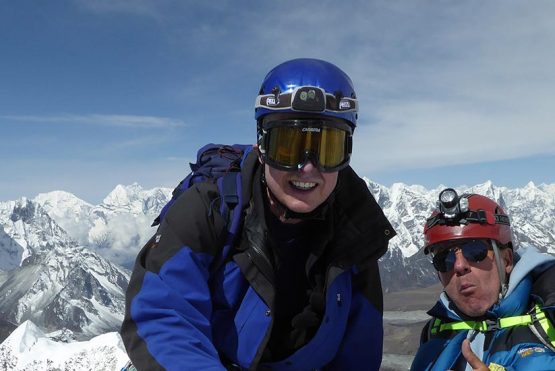
Lobuche East (6,119m/20,076ft) is technically harder than Island Peak (6,189m/20,306ft) despite its lower summit, involving more sustained rock and ice climbing on exposed terrain. Himalayan Glacier offers both as 19-day expeditions combined with Everest Base Camp for US $4,599 per person. Island Peak is the more common first-timer’s choice; Lobuche East suits climbers who already have some mountaineering mileage.
Trekkers who have completed the Everest Base Camp trail and want to go one step further often narrow their choice down to two peaks in the Khumbu region: Lobuche East and Island Peak (Imja Tse). Both summits sit above 6,000m / 19,685ft, both are climbed as an extension of the Everest Base Camp Trek, and both are offered by Himalayan Glacier as guided 19-day expeditions.
The two climbs are not interchangeable. Lobuche East demands more technical rock and ice climbing on a narrower, more exposed summit ridge, while Island Peak is built around a single steep headwall and glacier crossing that is more approachable for a first-time climber. This guide compares altitude, cost, technical demands, itinerary structure, and permits side by side, using Himalayan Glacier’s published trip data for both routes.
What Is the Difference Between Lobuche East and Island Peak?
Lobuche East and Island Peak are both classified as “trekking peaks” by the Nepal Mountaineering Association, meaning they can be climbed without a full mountaineering expedition permit, but the similarities largely end there. Lobuche East sits on the ridge above Lobuche village along the main Everest Base Camp trail, while Island Peak rises from the Chhukung valley on a separate side route via Kongma La pass.
| Feature | Lobuche East | Island Peak (Imja Tse) |
| Elevation | 6,119m / 20,076ft | 6,189m / 20,306ft |
| Location | Above Lobuche village, main EBC trail | Chhukung valley, side route off EBC trail |
| First ascent | 1984 | 1953 |
| Trip grade (Himalayan Glacier) | Demanding + Challenging | Demanding + Challenging |
| Duration with EBC trek | 19 days | 19 days |
| Price (Himalayan Glacier, twin share) | US $4,599 | US $4,599 |
| Popularity among climbers | Lower; fewer operators run it | Higher; most-climbed trekking peak in Nepal |
| Best suited for | Trekkers with some prior climbing exposure | First-time 6,000m climbers |
HIMALAYAN GLACIER GUIDE NOTE Himalayan Glacier’s own multi-peak itineraries, which combine Pokalde, Island Peak, and Lobuche East in a single trip, sequence the climbs from easiest to hardest in that exact order, placing Lobuche East last because of its escalating technical demand.
How Does the Climbing Difficulty Compare?
Both peaks require crampons, an ice axe, a climbing harness, and fixed-rope technique, and neither demands prior technical climbing certification. The difference lies in how sustained and exposed the technical sections are.
Lobuche East: Rock, Then Ice, on a Narrow Ridge
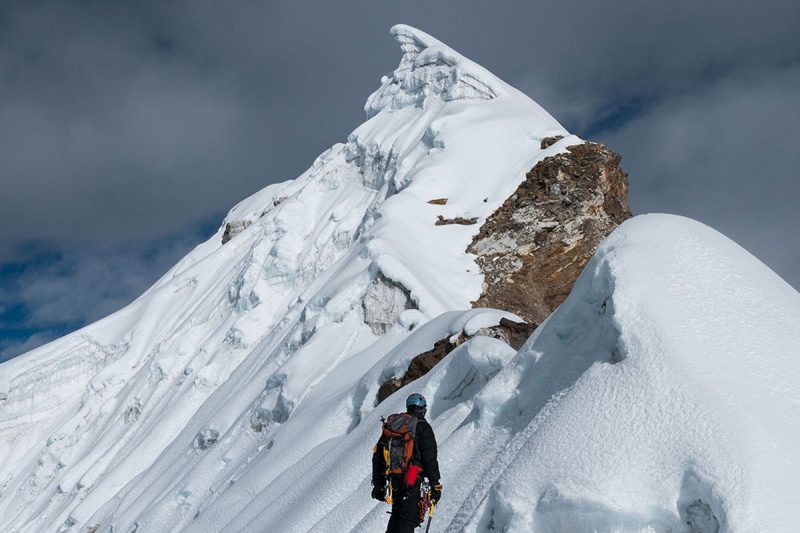
Climbers on Lobuche East move over rock terrain up to roughly 5,700m/ before the route transitions to ice. From there, fixed rope and hand line are used to the summit ridge, which is narrower and more exposed than Island Peak’s final approach. Himalayan Glacier’s own trip pages for its multi-peak itineraries describe Lobuche East as a bit more challenging than Island Peak, largely because of this longer mixed rock-and-ice section and the sustained exposure near the top.
Island Peak: One Headwall, Then a Ridge Walk
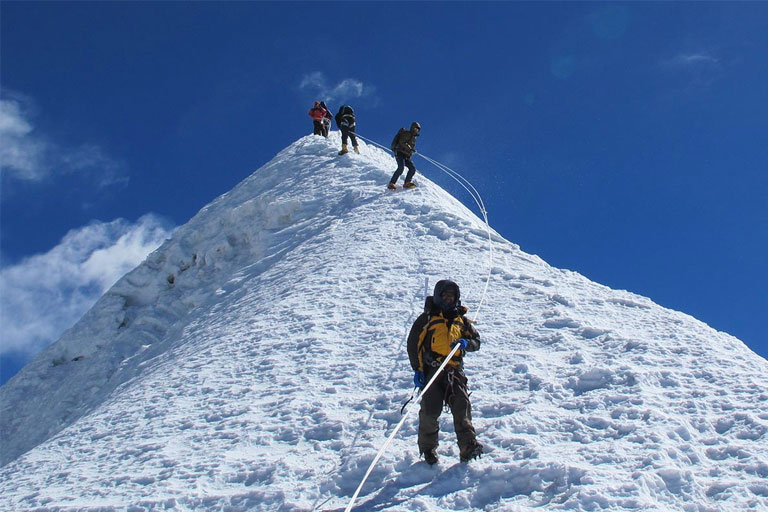
Island Peak’s technical crux is concentrated in a single, well-defined feature: a near-vertical ice headwall at roughly 6,000m, fixed with rope for the ascent. Climbers rope up for glacier travel below the headwall, cross two crevasses using ladders, then follow a snow ridge to the summit. Because the difficulty is concentrated in one section rather than spread across a longer ridge, most guiding operations consider it the more approachable of the two for a first serious mountaineering attempt.
| Technical Element | Lobuche East | Island Peak |
| Climbing surface below the crux | Rock to ~5,700m/18,700ft, then ice | Rock to ~5,770m/18,930ft, then glacier ice |
| Crux section | Extended mixed rock/ice ridge to summit | Single ice headwall near 6,000m/19,685ft |
| Rope work | Fixed rope and hand line throughout upper section | Fixed rope on headwall, roped glacier travel below |
| Crevasse crossings | Present, variable by season | Two, crossed via ladder |
| Summit exposure | Narrow ridge, more sustained exposure | Broader summit ridge, shorter exposed section |

Limited Spring 2027 Departures Are Filling Fast
Both the Lobuche East and Island Peak expeditions run on guaranteed group departures with a capped number of climbing spaces per season. Spring dates for 2027 are already showing reduced availability.
Check Departure Dates of Lobuche East →
What Do the Two Climbs Cost With Himalayan Glacier?
Priced identically at US $4,599 per person on a twin-share basis, both 19-day expeditions work out to US $242 per day, covering domestic flights, permits, standard hotel accommodation in Kathmandu, teahouse lodging on the trek, camping at the peak base camp, all meals in the mountains, and a Sherpa climbing guide.
| Cost Item | Lobuche East Peak Climbing with EBC Trek | Island Peak Climbing with EBC Trek |
| Trip price (twin share) | US $4,599 | US $4,599 |
| Price per day | US $242 | US $242 |
| Single supplement | US $485 | US $465 |
| Market range across operators | Contact for current pricing | US $3,200 to US $4,600 |
| What’s included | Flights, permits, hotels, teahouses, camping, meals, guide | Flights, permits, hotels, teahouses, camping, meals, guide |
| Not included | International flights, personal gear, tips | International flights, personal gear, tips |
Climbers wanting a shorter, climb-only itinerary without the full Everest Base Camp trek can also consider the 16-day Island Peak Expedition, or combine both summits with Everest Base Camp on the 22-day Lobuche East and Island Peak Expedition. Prices and current departure availability for every route are confirmed directly on the trip pages rather than estimated, since guaranteed-departure pricing can change by season.
For climbers who want to attempt both peaks in one trip, Himalayan Glacier’s Lobuche East and Island Peak Expedition combines both summits with a full Everest Base Camp and Kala Patthar itinerary over 22 days.
How Long Do the Two Expeditions Take?
Both itineraries run 19 days from arrival in Kathmandu to final departure, and both follow the identical Everest Base Camp trail through Namche Bazaar, Tengboche, and Gorak Shep before splitting for the summit push. The routes diverge at Lobuche.
Lobuche East Itinerary Structure
After visiting Everest Base Camp (5,364m/17,599ft) and Kala Patthar (5,545m/18,193ft), climbers move to a high camp at 5,400m/17,717ft directly above Lobuche village, then push for the Lobuche East summit at 6,119m/20,076ft on Day 13, an 8 to 10 hour climbing day. A contingency day is built in immediately afterward in case of bad weather.
Island Peak Itinerary Structure
The Island Peak route follows the same trail to Everest Base Camp and Kala Patthar, then crosses Kongma La pass (5,535m/18,159ft) to Chhukung before descending to Island Peak Base Camp at 5,200m/17,061ft. A dedicated pre-climb training day is scheduled at base camp before the summit push to 6,189m/20,306ft on Day 14, a longer 10 to 12 hour climbing day.
| Itinerary Milestone | Lobuche East (Day) | Island Peak (Day) |
| Fly Kathmandu to Lukla | Day 3 | Day 3 |
| Acclimatization days before EBC | 2 (Namche, Dingboche) | 1 (Namche) |
| Everest Base Camp visit | Day 10 | Day 9 |
| Kala Patthar sunrise | Day 11 | Day 10 |
| Dedicated pre-climb training day | Not scheduled separately | Day 13, at base camp |
| Summit day | Day 13 (8-10 hrs) | Day 14 (10-12 hrs) |
| Contingency/weather buffer day | Day 14 | Built into base camp days |
| Return to Lukla | Day 17 | Day 17 |
NOTE Himalayan Glacier’s guides recommend that climbers without recent high-altitude experience favor the Island Peak itinerary’s built-in training day, which walks through crampon technique, ice axe arrest, and ascender use at base camp the day before the summit push.


What Permits and Preparation Does Each Peak Require?
Both peaks require the same set of permits, since both fall within Sagarmatha National Park and both are regulated as NMA trekking peaks. A licensed climbing guide is mandatory for either summit under Nepalese mountaineering law; unguided solo ascents are not permitted.
- Nepal Mountaineering Association (NMA) climbing permit specific to the peak
- Sagarmatha National Park entry permit
- TIMS (Trekkers’ Information Management System) card
- Khumbu Pasang Lhamu Rural Municipality entry fee
Himalayan Glacier arranges and includes all four in both trip prices. Permit requirements and fees are set by the Nepal government and the NMA and are subject to change; current requirements are confirmed at the time of booking.
Physical preparation for either climb should begin three to four months out, combining cardiovascular conditioning, loaded pack hiking, and general strength work. Climbers able to comfortably carry a 20 to 25 pound (9 to 11kg) pack on sustained uphill terrain, ideally with prior trekking experience above 4,000m/13,123ft, are typically well positioned for either route.
Talk to a Himalayan Glacier Climbing Specialist
Get a free consultation on which peak matches your fitness level and experience, backed by a 98% summit success rate and Feefo-verified client reviews.
Which Peak Is Better for First-Time Climbers?
Island Peak is the more common choice for a first 6,000m/19,685ft summit. Its technical difficulty is concentrated in one clearly defined headwall rather than spread across a longer exposed ridge, and Himalayan Glacier builds a dedicated pre-climb training day into the itinerary immediately before the summit attempt. It is also the most-climbed trekking peak in Nepal, meaning route conditions, fixed-line placement, and guide familiarity tend to be more consistent season to season.
Lobuche East is better suited to climbers who already have some mountaineering mileage, whether that is a prior trekking peak summit, glacier travel experience, or general comfort on exposed rock and ice terrain. Its narrower summit ridge and longer mixed climbing section reward climbers who are not encountering fixed-rope technique for the first time.
HIMALAYAN GLACIER GUIDE NOTE Himalayan Glacier’s guides note that trekkers who have completed a prior high-altitude trek, such as Everest Base Camp or the Annapurna Circuit, but have no technical climbing background, generally have a smoother first experience on Island Peak than on Lobuche East.
Which Peak Offers Better Mountain Views?
Both summits deliver 360-degree Himalayan panoramas, but the specific mountains in view differ. From the Lobuche East summit, climbers see Everest, Lhotse, Nuptse, Ama Dablam, Cholatse, and Pumori in a single sweep, a wider spread of 8,000m and near-8,000m peaks than most other trekking peaks in the region offer.
Mount Everest itself is not visible from the Island Peak summit, since the peak sits directly behind Lhotse’s broad southern shoulder. Island Peak instead offers close-up views of Ama Dablam, Lhotse, Nuptse, Baruntse, and Makalu. Climbers wanting a close-up Everest view on either itinerary get it earlier in the trip, from Kala Patthar (5,545m/18,193ft) and Everest Base Camp (5,364m/17,599ft) on Day 10 or 11.
Frequently Asked Questions
Lobuche East is harder to climb than Island Peak, despite its slightly lower summit elevation of 6,119m/20,076ft compared to Island Peak’s 6,189m/20,306ft. The difficulty comes from a longer mixed rock-and-ice section and a narrower, more exposed summit ridge, versus Island Peak’s single, well-defined ice headwall.
A physically fit beginner with no technical climbing background can climb Island Peak with proper guiding and the pre-climb training session Himalayan Glacier builds into its itinerary. Lobuche East is possible for a fit beginner too, but it is better suited to climbers who already have some prior trekking peak or glacier travel experience.
Himalayan Glacier’s 19-day Lobuche East Peak Climbing with Everest Base Camp Trek and 19-day Island Peak Climbing with Everest Base Camp Trek are both priced at US $4,599 per person on a twin-share basis, or US $242 per day, covering flights, permits, accommodation, and meals.
No formal climbing certification is required for either peak, but prior high-altitude trekking experience above 4,000m/13,123ft is strongly recommended for both. Island Peak’s built-in training day makes it more forgiving for climbers with no rope or crampon experience; Lobuche East rewards climbers who already have some.
Spring, from March to early June, and autumn, from September to November, are the best seasons for both peaks, offering the most stable weather and clearest views. Spring is the busier of the two climbing seasons on both routes.
Yes. Himalayan Glacier’s 22-day Lobuche East and Island Peak Expedition combines both summits with a full Everest Base Camp and Kala Patthar itinerary, including a rest day between the two climbs to recover before the second summit push.
Ready to Choose Your Himalayan Summit?
Since 1992, Himalayan Glacier has guided climbers up both Lobuche East and Island Peak with a 98% success rate, backed by a Baltimore, MD based support office for easy international booking.