Tsum Valley’s main monasteries are Mu Gompa (~3,700m / 12,140ft), the valley’s highest and largest gompa; Rachen Gompa, its principal nunnery; Milarepa’s Piren Phu meditation cave; and the smaller Dephyudonma and Chumling gompas along the trail. All are reached on the Tsum Valley Trek, a 19-day round trip from Kathmandu operated by Himalayan Glacier.
Most Tsum Valley trip descriptions treat its monasteries as a line on an itinerary: “Day 11, visit Mu Gompa.” This guide flips that order. It profiles each significant monastic site in Tsum Valley on its own terms, then explains how a trek fits around them. Tsum Valley sits in a restricted border region of Nepal’s Gorkha district, closed to outside visitors until 2008, which is part of why its Tibetan Buddhist monastic culture remains so intact.
What Makes Tsum Valley’s Monasteries Different from Other Nepal Treks?
Tsum Valley’s monasteries sit inside a valley long known to Tibetan Buddhists as Beyul Kyimolung, or the “Hidden Valley of Happiness,” one of several sacred hidden lands said to have been blessed by the eighth-century Buddhist master Padmasambhava. That framing matters because it explains why the gompas here were built where they were: not as waypoints for travelers, but as retreats for a community that considered the entire valley sacred ground.
The Tsumba people, the valley’s Tibetan-origin inhabitants, maintain their own dialect, dress, and religious customs, largely undiluted by the tourism that has reshaped nearby Everest and Annapurna routes. Himalayan Glacier’s guides note that the region’s isolation, it was a restricted area until 2008, kept its monasteries functioning as living community centers rather than heritage sites managed for visitors.
Every monastery covered in this guide is reached on foot, over multiple days, through terrain that itself forms part of the pilgrimage. There is no road access and no shortcut.
Tsumba family structure is unusually distinct from the rest of Nepal: the valley’s tradition of fraternal polyandry, in which brothers within a family share a single wife, is still practiced by some households. Trekkers who ask their guide about local customs, rather than only photographing monastery facades, tend to come away with a fuller picture of how the valley’s Buddhist practice and daily life intertwine.

What Is Mu Gompa, and Why Is It the Valley’s Most Important Monastery?
Mu Gompa sits at ~3,700m / 12,140ft, the highest point on the standard Tsum Valley Trek and the largest monastery in the region. It occupies the highest, most remote section of the valley, close enough to the Tibetan border that trekkers can sense the shift in landscape and light.
Mu Gompa is reached on day 11 of Himalayan Glacier’s 19-day itinerary, with a full sightseeing day at the monastery on day 12 before the group begins the return route. That extra day allows time to explore the wider Mu Gompa area, including the nearby Dephyudonma Gompa, and, for trekkers with extra stamina, an optional side trip toward the base of Pika Himal (~4,865m / 15,961ft).
- Altitude: ~3,700m / 12,140ft, the trek’s maximum elevation
- Reached: Day 11 of the 19-day Tsum Valley Trek itinerary
- Status: The largest and highest-altitude monastery in Tsum Valley
- Nearby site: Dephyudonma Gompa, a short walk from the main complex
Walk the Trail to Mu Gompa This Season
Spring departures for the Tsum Valley Trek are limited to keep group sizes small on these remote trails. Secure a place before the spring 2027 window fills.
Check Spring Availability!
What Happens at Rachen Gompa, the Valley’s Main Nunnery?
Rachen Gompa is Tsum Valley’s principal nunnery, home to a community of Buddhist nuns who maintain a daily schedule of prayer and ritual. Trekkers reach it on day 10 of the standard itinerary, after crossing a rope suspension bridge past the village of Lamagaon, on the way toward Nile.
Himalayan Glacier’s itinerary allows a short visit to Rachen Gompa rather than a full day, since it falls partway through a longer walking day toward Nile at ~3,361m / 11,027ft. Most trekkers passing through can view the nunnery’s prayer hall and grounds and, depending on the timing of their visit, hear the nuns’ chanting.
Most trekkers on this route experience Rachen Gompa as a quieter counterpart to Mu Gompa: smaller in scale, but no less active as a functioning religious community.
Where Is Milarepa’s Piren Phu Cave, and Can Trekkers Visit It?
Milarepa’s Piren Phu Cave is a meditation site associated with the 11th-century Tibetan yogi-poet Milarepa, one of Tibetan Buddhism’s most revered historical teachers. It sits above Burgi village, reached on day 13 of the Tsum Valley Trek as the group begins its return journey from Mu Gompa.
The cave, its name, Piren Phu, translates roughly to a site of pigeons, is known for the views from its mouth across the Poshyop Glacier, Kipu Himal, and Churke Himal. Reaching it involves a climb above Burgi village after a full day’s trek back through Chhule and Phurbe on the east bank of the Shiar Khola.
Yes, trekkers on the standard itinerary can visit the cave; it is included as part of day 13’s route rather than an optional add-on, though the short climb up to the cave entrance adds time to an already long trekking day.


What Other Monasteries and Sacred Sites Are Found in Tsum Valley?
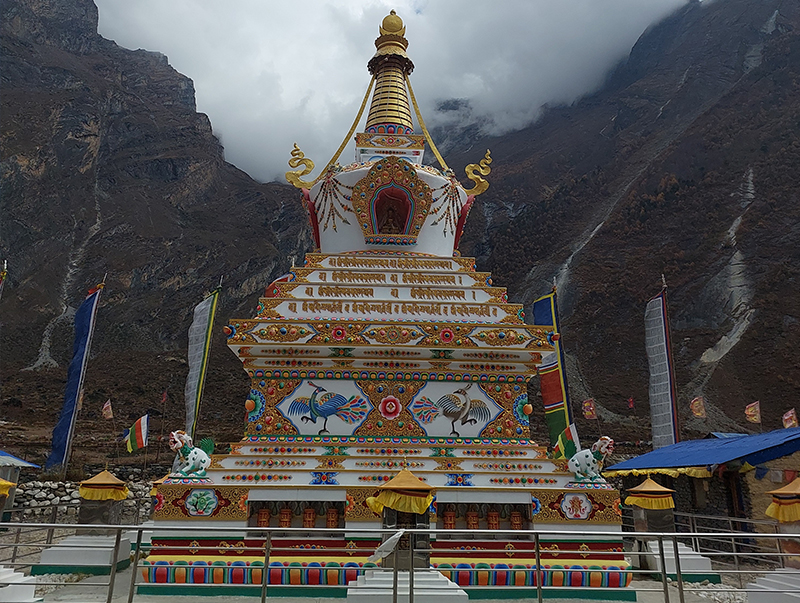
Beyond Mu Gompa, Rachen Gompa, and Milarepa’s cave, several smaller sites round out the valley’s religious landscape:
- Dephyudonma Gompa: A nunnery near Mu Gompa, visited on the same day as the main complex.
- Chumling Gompa: An old monastery in Chumling village, reached on day 8 of the standard itinerary, in the lower part of the valley.
- Gumba Lungdang: A monastery situated at the base of a hill on the main slope of Ganesh Himal, more commonly reached on extended itineraries or side trips rather than the standard 19-day route.
Each of these sites reflects the same pattern: a small, active religious community, built into terrain that took a full day’s walk to reach and still does.
Tsum Valley Monasteries at a Glance
| Site | Altitude | Trek Day | Type |
| Chumling Gompa | ~2,386m / 7,828ft | Day 8 | Village monastery |
| Rachen Gompa | ~3,010-3,361m / 9,876-11,027ft | Day 10 | Nunnery |
| Mu Gompa | ~3,700m / 12,140ft | Day 11-12 | Main monastery (largest) |
| Dephyudonma Gompa | ~3,700m / 12,140ft (near Mu Gompa) | Day 11-12 | Nunnery |
| Milarepa’s Piren Phu Cave | Near Burgi village, ~3,245m / 10,647ft | Day 13 | Meditation cave |
What Is the Shyagya Tradition, and How Does It Shape Life in the Valley?
Tsum Valley has followed a formal code of non-violence, known locally as the Shyagya tradition, since the 1920s. Under Shyagya, hunting, trapping, and the killing or sale of animals for slaughter are all forbidden throughout the valley, a practice rooted directly in Tibetan Buddhist teaching on non-harm.
This is one of the details that separates Tsum Valley from almost every other trekking region in Nepal. The valley’s monasteries did not simply coexist with the surrounding wildlife and livestock; the Shyagya code formally protects it, and local leaders have renewed the commitment through community festivals held periodically since the tradition began.
For trekkers, the practical effect is visible rather than abstract: wildlife such as the Himalayan tahr moves more freely near the trail than in most other Himalayan valleys, and the region’s mani walls and chortens, stone structures inscribed with prayers, are treated with particular care by the Tsumba community.
How Do You Reach These Monasteries?
All of Tsum Valley’s monasteries are reached on the Tsum Valley Trek, a 19-day round-trip itinerary from Kathmandu, offered by Himalayan Glacier at US $2,950 per person, or roughly US $155 per day. The trek starts and ends in Arughat, a 7-8 hour drive from Kathmandu, and follows the lower Budhi Gandaki valley before branching north into Tsum.
The itinerary is rated demanding, with daily walks of 4-7 hours over uneven, often steep terrain, though it involves no technical climbing, rope work, or glacier travel. Total hiking time across the trek runs 71-82 hours, with 14-16 hours of driving and a total travel distance of 125km / 78 miles.
Tsum Valley Trek: Key Trip Facts
| Detail | Figure |
| Duration | 19 days, Kathmandu to Kathmandu |
| Price | US $2,950 per person (US $155/day), twin-share basis |
| Maximum altitude | ~3,700m / 12,140ft, at Mu Gompa |
| Trip grade | Demanding |
| Start / end point | Arughat (7-8 hour drive from Kathmandu) |
| Single supplement | US $290 |
| Group requirement | Minimum two trekkers; solo trekking not permitted |
Because Tsum Valley sits in a restricted border area, every trekker needs a Restricted Area Permit and a Manaslu Conservation Area Permit, arranged in advance. Himalayan Glacier’s published rates put the Restricted Area Permit at approximately US $40 per person for the first week in autumn, or US $30 in other seasons, plus US $7 per additional day, with a minimum group size of two.
Contact Himalayan Glacier directly for current permit rates and season-specific pricing, since permit fees are set by Nepal’s government and can be revised outside the operator’s control.
When Is the Best Time to Visit Tsum Valley’s Monasteries?
The best time for the Tsum Valley Trek is spring (March to May) or autumn (September to November), when clear skies give the best views of Ganesh Himal and Himalchuli around the monastery sites. Winter trekking is possible but cold; the summer monsoon brings landslide risk along the road approach to Arughat.
Because Mu Gompa’s altitude peaks at a comparatively moderate ~3,700m / 12,140ft, well below the elevations where acute mountain sickness becomes common, altitude-related risk on this route stays low to moderate across both main trekking seasons.
What Should Trekkers Know Before Visiting?
A few practical points shape how a visit to Tsum Valley’s monasteries should be planned:
- Every trekker needs a licensed guide; Nepal’s restricted area rules do not permit solo trekking in Tsum Valley.
- Dress modestly near monasteries and ask permission before photographing nuns, monks, or religious ceremonies.
- Walk clockwise around chortens and mani walls, in keeping with local Buddhist practice.
- Accommodation en route is in simple teahouses and lodges on a twin-share basis; a single supplement is available.
- Meals are full board but simple, dal bhat, Tibetan bread, and tsampa porridge are the norm this far into the valley.
Himalayan Glacier’s guides recommend building in the itinerary’s built-in acclimatization at Mu Gompa’s two-night stay rather than rushing the return leg, since the extra day allows time to properly take in Dephyudonma Gompa and the surrounding area.
Trekkers wanting more menu variety than the standard teahouse fare can arrange a dedicated trekking kitchen team in advance, at additional cost, since the valley’s remoteness means teahouse menus stay limited to a handful of simple, filling dishes. Packing for demanding, variable-weather days matters more here than on busier routes, given the more limited rescue and resupply infrastructure this far into a restricted area.
Frequently Asked Questions
The Tsum Valley Trek visits Chumling Gompa, Rachen Gompa (the valley’s main nunnery), Mu Gompa (the largest and highest, at ~3,700m / 12,140ft), the nearby Dephyudonma Gompa, and Milarepa’s Piren Phu meditation cave. All are visited on Himalayan Glacier’s standard 19-day itinerary.
Yes. Mu Gompa functions as an active monastery and remains the largest and highest-altitude religious site in the valley, at ~3,700m / 12,140ft. Trekkers spend a full sightseeing day there as part of the standard itinerary.
The Shyagya tradition is a formal code of non-violence practiced in Tsum Valley since the 1920s, under which hunting, trapping, and the killing or sale of animals for slaughter are forbidden throughout the valley. It is rooted in Tibetan Buddhist teaching on non-harm and is still actively observed by the Tsumba community.
Yes. Trekkers overnight in teahouses and lodges in villages near the monasteries, including a two-night stay near Mu Gompa itself. Accommodation is on a twin-share basis, with a single supplement of US $290 available.
Yes. Milarepa’s Piren Phu Cave, above Burgi village, is included in the standard Tsum Valley Trek itinerary on day 13, as trekkers begin their return route from Mu Gompa.
No special permission beyond the standard Tsum Valley permits is required to visit Rachen Gompa. It sits directly on the main trekking route, reached on day 10 of Himalayan Glacier’s itinerary, and is included as a standard stop.
Visit Tsum Valley’s Living Monasteries With On-the-Ground Experts
Himalayan Glacier has guided trekkers through Nepal’s Himalayas since 1992, with a Baltimore, MD support office handling booking and questions for international travelers. Reach out to start planning the 19-day Tsum Valley Trek.