


Are you planning on doing the Everest Base Camp Trek? However, stress about the difficulty level of the trek.
The trek to Everest Base Camp is considered one of the demanding adventures, full of experiences — the trek leads you to the base of Mount Everest at 5,364m(17,598ft). Trekkers typically walk 6 to 7 hours daily across bridges, local villages, and high-altitude terrain. The hike doesn’t need any technical skills, however it does test your endurance, determination, and ability to adapt to increasing altitude.
Still, many trekkers frequently ask if it is really that tough to reach the base of the highest mountain in the world. You have to be prepared and, at the same time, trek at a gentle pace, patient with every step from steep ups and rough trails to adapting to changing weather conditions. Moreover, with the right attitude, training, and the right guidance, the challenge will turn into a great experience -both physically and mentally- that is full of rewards.
Is High Altitude a major problem?
Most often, people have got a lot of queries to know about the problems which arises due to high altitude. Well, as per Rozycki & Dryglas (2014) in their study “Trekking in Modern world” have assumed that, on an average up to 5,300m(17,388ft.) above sea level, human body can acclimatize.
| Altitude | Oxygen Level |
|---|---|
| Sea Level | 100% |
| 1,000m / 3,281ft. | 88% |
| 2,500m / 8,202ft. | 73% |
| 3,000m / 9,843ft. | 68% |
| 3,500m / 11,483ft. | 64% |
| 4,000m / 13,123ft. | 60% |
| 4,500m / 14,764ft. | 57% |
| 5,000m / 16,404ft. | 53% |
| 5,364m / 17,599ft. (Everest Base Camp) | 50% |
Acute Mountain Sickness (AMS) is a problem related to the gain in altitude. People rarely get this problem below 2,800m (9,186ft.), and you get to see few cases within 3,000m (9,842ft.). An important information to keep in mind is that, above 5,500m (18,044ft.) from sea level only 50% of oxygen is present in the air. Below this, the percentage of oxygen in air is comparatively higher; meaning your body can adjust the surrounding environment of Everest base camp training if you have proper food and rest to the body.
Note: Himalayan Glacier has successfully assisted people from 17-year to 70-year-old age group for Everest base camp trek several times in last three decades.
For more information regarding symptoms and preventive methods in altitude please check our Altitude sickness in Everest Trek. This link will give you more in-depth idea on altitude sickness and the possible remedies to adopt during the time of emergencies and difficultly on Everest base camp trek. Furthermore, our guides have undergone training on Wilderness First Aid (WFA). They act as a medical assistant during emergencies.
Training required for Everest Base Camp Trek
In order to get going for Everest Base Camp, you need to make some pre-preparation before landing to the country of Mount Everest.
Mental stability
– Proper balanced diet, yoga and confidence
A proper balanced diet helps regulate your body metabolism in a well-organized manner. It also helps in reducing stress and increases mind stability. Moreover, regular yoga makes you calm and build up your immune system that prepares you for any unseen situations and helps overcome the Everest base camp trek difficulties.
Physical stability
– Jogging, exercising and short hike practices on regular basis
Regular physical exercise is a must as it boosts your ability to withstand long walks during a good hike. It helps to eliminate the problem of early fatigue or muscle cramps. Exercise could be jogging, swimming, small uphill hikes and attending gym.
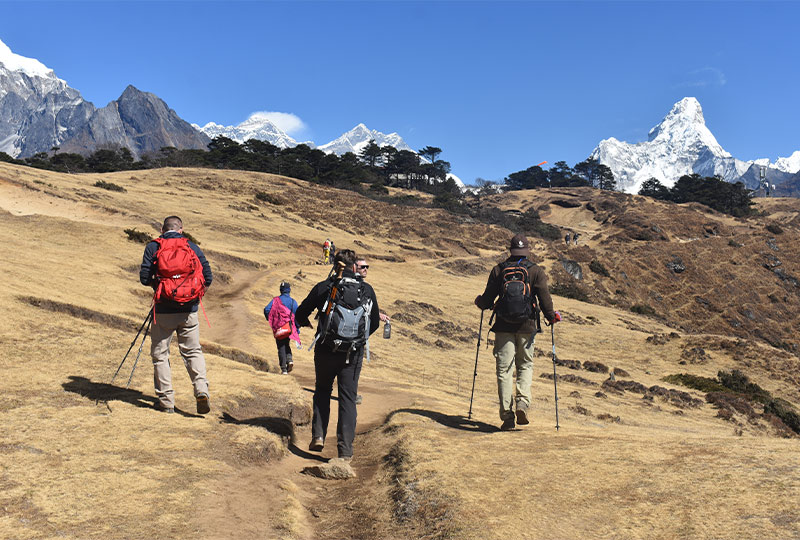
These two aspects are the major requirements for Everest base camp Trek Training. Besides, you require other good fitness conditions to complete the trek successfully.
We have two different Everest Base Camp trek itineraries. Our short Everest Base camp 14-day trek with previous trekking experience is perfect for trekkers. It is best for those with limited time, yet active and both physically and mentally fit.
Likewise, for slow-paced trekkers we have Everest Base camp 16-daypackage. This allows sufficient acclimatization time. Adventurers with good health and average physical fitness will also be in the trek.
Climate in the Everest region by Season
1. Spring Season
Spring is the most appropriate season to embark on the Everest base camp trek. The weather remains quite stable, and the temperature could vary from 15°c to 25°c during the day and -8°c to -20°c at night. The moderate weather conditions make it comparably easier to trek than cold or rainy weather, reducing physical strain. Overall, it’s one of the easiest and most scenic seasons for the EBC trek. This season gets a good flow of tourists.
2. Monsoon Season
Monsoon falls under June – July month till August. This season is not good for trek. The road and trails get wet and muddy most of the time due to the rainfall. The slippery trails and probable landslides could even cause severe casualties. Although it’s warmer, the humidity can make trekking uncomfortable. This season is best for experienced trekkers who can handle wet and unpredictable conditions.
3. Fall Season
Fall is next best time to do the Everest base camp trek after spring season. With the beginning of cold weather, it has its own beauty that pays well to your satisfaction. A soothing chilled morning and gentle warmth during day makes you feel great to walk. It’s the peak trekking season, so trails and teahouses can get crowded. Still, in terms of climate, this is the most balanced and beginner-friendly period for the Everest Base Camp Trek.
4. Winter Season
Winter brings cold dropped temperature with good pile of snowfall. The temperature could get down to -17°c. It is generally off season for trekking. Snow-covered trails and icy winds make the trek physically demanding. However, the skies remain clear, offering breathtaking views. This season is suitable only for trekkers prepared for extreme cold and limited access to some higher lodges.
But then, few places like Gokyo Lake and Mera Peak in Everest region are great substitutes as winter fun destinations. Tourism industry of Nepal is promoting this packages these days.

Overall, the best time to trek Everest Base Camp trek is during Autumn (September to November) and Spring (March to May). During these seasons, the weather is favorable, trail are well-maintained, and offers clear and panoramic mountain views. Check out the article on best time for Everest Base Camp trek to learn the different climate conditions.
Packing List for Everest Base Camp Trek
It is indeed necessary to make some special bag packing during the time of trek. All those necessary stuffs in the backpack are the lifesavers, to a certain extent, during the trek. Some of the essential items that are needed for successful Everest trek completion are listed below:
- Layered Clothing (Fleece Jacket, Base Layers, Insulating Layers, Windproof/Waterproof Jackets)
- Sturdy Trekking Boots (High-Ankle, Waterproof)
- Backpack with Rain Cover
- Warm Hat and Gloves
- Sunglasses and Sunscreen
- Water Bottles and Purification Tablets
- First Aid and Altitude Medicine
- Headlamp with Extra Batteries
- Power Bank and Adapters
- Trekking Poles and Toiletries
Everyone desires to get all sorts of gears, equipment and clothes as many as possible. This is because of their sense of being out with the wilderness in the mountains. A detailed information regarding the Packing list for Everest base camp trek is a must to make the Everest Base Camp trek less difficult. The proper packing lists ensure a successful and enjoyable trek.
Everest Base Camp Trek Itinerary
Here is a day-to-day itinerary of the Everest Base Camp Trek below:
Day 1: Arrival in Kathmandu and Trip Preparation
Day 2: Fly from Kathmandu to Lukla and Trek to Phakding
Day 3: Trek from Phakding to Namche Bazaar
Day 4: Acclimatization Day in Namche Bazaar
Day 5: Trek from Namche Bazaar to Tengboche
Day 6: Trek from Tengboche to Dingboche
Day 7: Acclimatization Day in Dingboche
Day 8: Trek from Dingboche to Lobuche
Day 9: Trek from Lobuche to Gorak Shep and Visit Everest Base Camp
Day 10: Trek from Gorak Shep to Kala Patthar and Descend to Pheriche
Day 11: Trek from Pheriche to Namche Bazaar
Day 12: Trek from Namche Bazaar to Lukla
Day 13: Fly Back from Lukla to Kathmandu
Day 14: Final Departure – A Warm Goodbye
So, are you ready to trek to the Everest Base Camp?
Take the first step toward your Himalayan dream and test your limits on one of the world’s most iconic trekking adventures.
Check the full Itinerary!
Trekking solo vs trekking with agency?
An individual’s travel perception can influence people travel either in groups or even solo. It won’t be a great deal to walk in the trekking trails but it’s a risk to travel to the place where everything seems to be similar meaning; one can easily lose track resulting in some unwelcome incidents.

Getting a tour operator is to get the benefit of the following aspects:
- Reducing the chances of scams or forgeries, in any case.
- Experiencing the hospitality that gives you a great motivation and comfort for your exciting journey.
- Making logistics easy for transportation, permits, accommodation, health tips and money exchange.
- Helping in navigation and easy communication with the locals
As experience counts, so travel-adventure companies like Himalayan Glacier works as a companion and provides the service of hassle-free trek.
Three-decade long expertise in trekking enables us to provide you the service for reducing Everest base camp trek difficulty without any glitches. We have highly proficient guides with decades-long experience in the mountains. Their communications skills are excellent. They have trainings for navigation, altitude sickness, and dealing with other emergency situations at high altitudes. All our guides carry necessary basic first aid supplies that comes handy during emergencies.
Do you know about the weather of Mt. Everest summit?
Well, Everest summit is one of the coldest and windiest places on earth. The extreme temperature may get to -63°C during January. Whereas the summer temperature would be around -18°C. The wind speed could be at 174 mph. The facts about Mt. Everest weather can showcase that, difficulty to Everest base camp trek is higher. But all the information in detail is definitely a key to make it lot easier to summit.
Conclusion
The Everest Base Camp Trek is not just a physical challenge, it’s mental and physical journey. While altitude, weather, and long walking days can make the trek demanding, proper preparation and a steady pace make it achievable for most trekkers with moderate fitness.
The challenge is mostly dependent on the preparation rather than on the trail itself. With the right attitude, proper training, and trustworthy trekking companions, the journey to the Everest Base Camp can be successful.
Ready to conquer the Everest Base Camp Trek?
Connect with our dedicated Everest team and get a detailed trek tips, real-time guidance, and start your journey to the base of the world’s tallest mountain.
👉 Talk to an Expert

Sudarshan Devkota is a passionate trekking leader with the immense knowledge of trekking and mountains of Nepal. With his strong belief and determination, he has led travelers from around the world to the famous trekking trails of Nepal namely Everest, Annapurna, Manaslu, Langtang and many more.

